Daily Top US Stock Picks — June 2, 2026: DELL & NVDA
S&P 500 at 7,580 (9-week ATH streak). Two AI infrastructure plays dominate today's tape: Dell Technologies surged 33% on record Q1 FY27 earnings (revenue +88% YoY, AI server revenue +757%), while Nvidia closed +5.7% after unveiling the RTX Spark AI PC superchip and confirming Vera Rubin production ramp. Full thesis, fundamentals, technicals, risk factors, and 1–3 month strategy for both picks.

Daily Top US Stock Picks — June 2, 2026
Macro & market sentiment overview
The S&P 500 closed Monday at 7,580.07 — another all-time high — extending its winning streak to nine consecutive weekly gains.1 The Nasdaq Composite added +0.6%, paced by semiconductors and mega-cap AI names, while the Dow Jones Industrial Average edged up +0.1%. Goldman Sachs lifted its year-end S&P 500 target to 8,000, citing the completion of a historically strong Q1 earnings season in which index-level earnings grew +27.7% year over year with 97% of constituents reporting.2
Two macro factors are pulling in opposite directions today. On the positive side, the Chicago PMI jumped to 62.7 in May — well into expansion territory — signaling that US corporate activity is accelerating into Q2.3 On the negative side, the 10-year Treasury yield sits near 4.45%, with fed funds futures pricing roughly a 46% probability of another rate hike this cycle — a persistent overhang for rate-sensitive sectors and long-duration growth valuations.3 Geopolitically, US-Iran peace talks are advancing, which partially offset the oil-price spike (crude near $91); any de-escalation would relieve the energy-cost pressure currently weighing on industrial margins.4
The risk calendar for the remainder of the week is dense: US job openings and euro-area flash inflation print on Tuesday, June 3 ISM Manufacturing data lands Wednesday, and Broadcom (AVGO) Q2 earnings on Wednesday will serve as the next read on data center capex durability.
Net assessment: The tape remains constructive — index breadth is narrow but Q1 earnings quality is robust. Near-term risk is not a demand cliff but a rates-and-supply-chain squeeze. Today's two picks are positioned to benefit from the AI infrastructure buildout even under these constraints.
:max_bytes(150000):strip_icc()/GettyImages-2278584369-c289dc25050641b48a9c960d368e67bc.jpg)
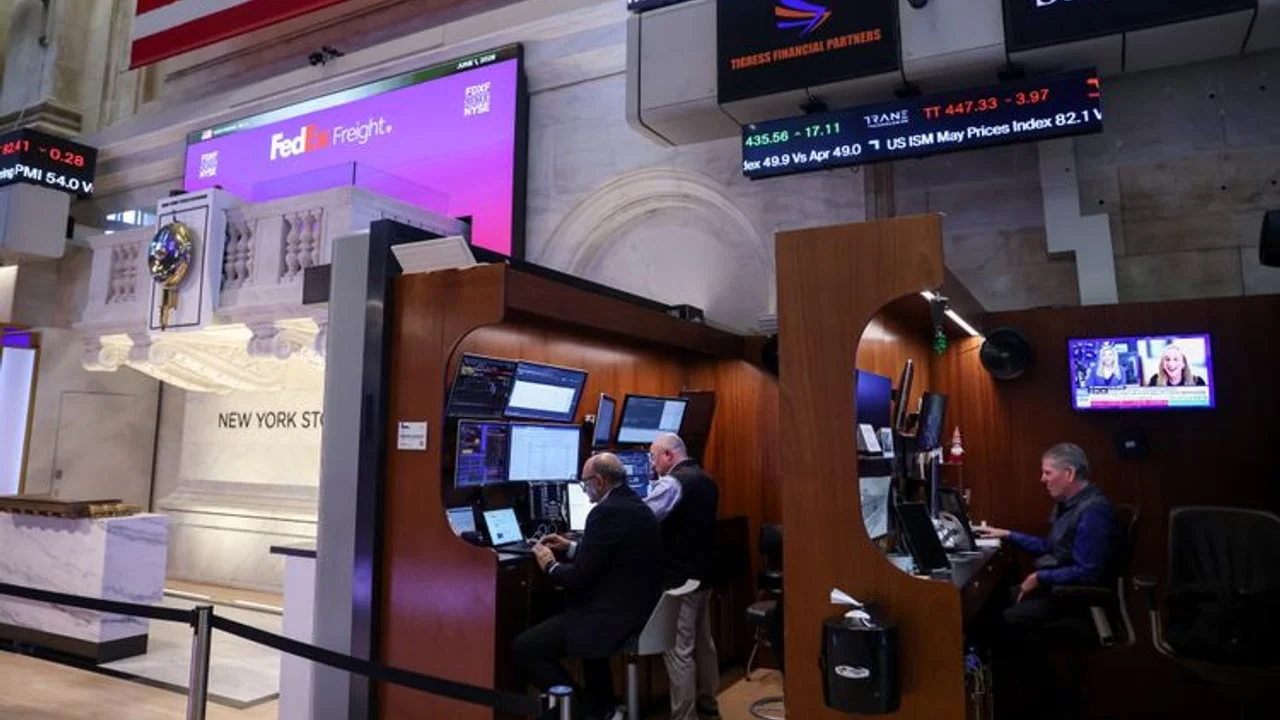
NYSE floor, June 2026 — S&P 500 posts 9th consecutive weekly gain 4
Core recommended tickers
Pick 1: DELL — Dell Technologies
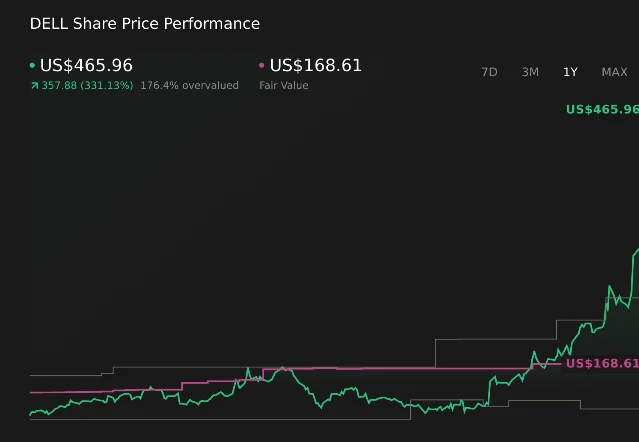
Current price (June 1 close): ~$195 (post-earnings gap open)
Sector: Technology — IT Infrastructure / AI Servers
Investment thesis
Dell reported the highest revenue growth rate in its post-2018 public-market history: Q1 FY27 revenue of $43.8 billion, up 88% year over year, crushing the LSEG consensus of $35.4 billion.5 Adjusted EPS of $4.86 beat the $2.94 consensus by 65%. The company simultaneously raised FY27 revenue guidance by $27 billion and EPS guidance by $5 — a magnitude of upward revision that is rare for a company of Dell's scale.6 The engine is AI server demand, which is still exceeding supply — not an artificial inventory cycle.
Fundamental highlights
| Metric | Q1 FY27 result | Year-over-year change |
|---|---|---|
| Total revenue | $43.84B | +88% |
| Infrastructure Solutions Group (ISG) revenue | $29.0B | +181% |
| AI server revenue | $16.1B | +757% |
| AI order intake | $24.4B | — |
| AI backlog (quarter-end) | $51.3B | Record |
| Non-GAAP EPS | $4.86 | +214% |
| Operating cash flow | $4.1B | Q1 record |
FY27 guidance: revenue $165–$169B (implied ~+47-50% YoY at midpoint) and ~$60B in AI server revenue — up from the prior $50B forecast.5 On the competitive-advantage side, Dell's ability to package GPUs, networking, and storage into rack-scale solutions gives it a pricing and logistics moat over white-box assemblers: ISG gross margin expanded to 10.5%, up 80 basis points YoY even as AI server mix (lower margin individually) grew ~800% — a sign of scale leverage and services attach.6 Additionally, a five-year Pentagon contract worth $9.7 billion for Microsoft 365 services, announced May 27, diversifies Dell's government revenue base.5
One structural note: the $51.3B AI backlog is roughly 1.2× a full quarter of ISG revenue, providing meaningful forward revenue visibility even if new order intake decelerates.
Technical signals
DELL surged +32.76% on June 1 on volume well above average — a volume-price surge breakout from the post-Q4 consolidation range.3 The stock has gained more than 150% year to date, against the S&P 500's ~10% advance.5 After a gap-up of this magnitude, the price will likely consolidate before the next directional move. The 50-day moving average sits well below current levels, and the RSI is likely overbought on the daily chart in the near term — which is expected and manageable following an earnings-driven rerating event. The prior resistance zone (~$150-160) now becomes a key support shelf. Management's Q2 guidance of $44–$45B revenue and $4.80 adj. EPS — both well above prior Street estimates — gives the stock a fundamental floor.
Potential risk factors
Risk 1 — Component supply constraints with pricing inflation: Jeff Clarke explicitly flagged DRAM, NAND, CPUs, and hard drives as supply-constrained, and Dell reprices "every day." Higher input costs compress near-term gross margins and introduce execution risk if supply chains tighten further; the net impact could be meaningful if the memory cycle reverses and pricing power fades simultaneously. Management did not quantify the potential gross margin impact.
Risk 2 — AI capex concentration and customer dependency: Dell's ISG growth is heavily tied to a small set of large AI infrastructure spenders — neoclouds, sovereign clients, and large enterprises. A pause or phased reduction in AI capex (triggered by, for example, rising interest rates or a correction in AI model ROI assumptions) would compress orders faster than Dell can diversify the backlog.
Pick 2: NVDA — Nvidia Corporation
Current price (June 1 close): $224.33 (+5.7% on the day; +6.3% at intraday peak)
52-week high: $235.74 | 52-week range base: ~$75 (split-adjusted)
Sector: Technology — Semiconductors / AI
Investment thesis
At Computex 2026 in Taipei (June 1), CEO Jensen Huang delivered a dual market-expansion announcement that repositioned Nvidia's total addressable market in a single keynote.7 First: RTX Spark, Nvidia's first system-on-chip for Windows PCs — an Arm/MediaTek-built superchip delivering 1 petaflop of AI performance, 128GB unified memory via NVLink, and planned launch with Microsoft, Dell, HP, ASUS, Lenovo, and MSI across 30+ laptops and 10+ desktops by fall 2026. Second: Vera Rubin — Nvidia's next-generation data center platform combining the Vera CPU with the Rubin GPU — has entered full production, with OpenAI, Anthropic, xAI, Dell, Oracle, and CoreWeave as early customers, delivering 3.5× training performance and 5× inference performance vs. Blackwell.7 The strategic significance: Nvidia is simultaneously competing for AI compute at hyperscale (Vera Rubin) and on individual devices (RTX Spark) — two new demand nodes that did not exist in prior product cycles.
正在加载内容卡片…
Fundamental highlights
Nvidia's most recent fiscal quarter (Q4 FY26, reported February 2026) established the financial baseline for contextualizing today's news. The company has demonstrated sustained operating leverage across multiple cycles:
- Data center revenue now constitutes the dominant share of Nvidia's business, with Blackwell production ramping aggressively through H1 FY27.
- Analysts at Bank of America set a price target of $320, Wells Fargo at $315, and UBS at $275 ahead of the May earnings report — all reflecting consensus that the AI infrastructure spending cycle is not near a peak.7
- RTX Spark enters the PC processor segment — Intel fell ~5% and AMD dropped ~4% in direct response — indicating Nvidia is capturing margin from a new market rather than cannibalizing its own products.7
- Arm Holdings surged +12% on RTX Spark news, as the architecture underpins the chip — validating Arm's moat in power-efficient AI compute, and Nvidia's ability to amplify ecosystem value for its partners.7
A note on the consensus target price: current share price is $224.33 against a BofA target of $320 — implying roughly 43% upside to the highest published target. Analyst consensus targets carry a well-documented optimistic bias; these figures are directional, not guarantees.
Technical signals
NVDA traded over 150 million shares on June 1 — well above average daily volume — with a +5.7% close and intraday peak of +6.3%.7 The stock has had only 5 moves greater than 5% over the trailing year, making today's move statistically meaningful rather than routine noise. At $224.33, NVDA is trading within 5% of its 52-week high of $235.74, having recovered its full post-Q4-earnings dip. The daily RSI is elevated following the gap but has not reached the extreme overbought territory seen at prior cycle peaks. The key level to watch on the downside is $200 (psychological round number and prior breakout support); a hold above that zone on the next consolidation would confirm the continuation structure. MACD on the daily is in a bullish crossover, with momentum expanding.
Potential risk factors
Risk 1 — Valuation multiple compression from sustained high rates: NVDA currently trades at a significant premium to the S&P 500 on forward P/E. If the 10-year yield holds above 4.5% or pushes toward 5%, long-duration growth multiples face persistent compression pressure — even in the presence of strong earnings growth. The valuation premium is justified only if the AI infrastructure cycle continues to grow faster than consensus currently models.
Risk 2 — RTX Spark ramp execution risk and competitive retaliation: RTX Spark is Nvidia's first PC processor and is manufactured on TSMC's 3N process. Any yield issues, launch partner delays, or a faster-than-expected response from Qualcomm's Snapdragon X platform or Apple Silicon derivatives could limit the PC segment's contribution to FY27 revenue — creating a gap between today's re-rating and actual monetization.
Actionable investment strategy (1–3 month horizon)
DELL — Phased accumulation on post-earnings consolidation. After a +33% single-day move, expect a 3-7 session consolidation or minor retracement as fast-money longs book profits. The key support shelf is the prior resistance zone, approximately $145–$160. Add on confirmed closes above $170 with normal (not elevated) volume — this signals that institutional buyers are absorbing the float rather than selling into strength. A position initiated now carries high near-term event risk (momentum reversal); patience for a cleaner entry improves the risk/reward. The Q2 FY27 earnings report (expected August 2026) is the next major catalyst; the guidance of $44–$45B revenue and $4.80 EPS gives a concrete bar to measure against.
NVDA — Follow the Computex breakout, scale on pullbacks to $200. NVDA's current position near the 52-week high on high-volume catalyst news is a structurally strong setup. For investors not yet positioned, initiating a partial position now and scaling in on any pullback toward $200–$210 is reasonable. The RTX Spark fall 2026 product launch cycle and Vera Rubin production ramp represent two distinct revenue events that should sustain positive earnings revisions through Q3 FY27 (October 2026 reporting window). Stop discipline: a weekly close below $185 (below the recent breakout base) would indicate the thesis is not playing out on the expected timeline and warrants reassessment.
This report is for informational purposes only and does not constitute a recommendation to buy or sell any security. All investment decisions carry risk. Past performance does not guarantee future results. Data sourced as of June 1–2, 2026.
围绕这条内容继续补充观点或上下文。