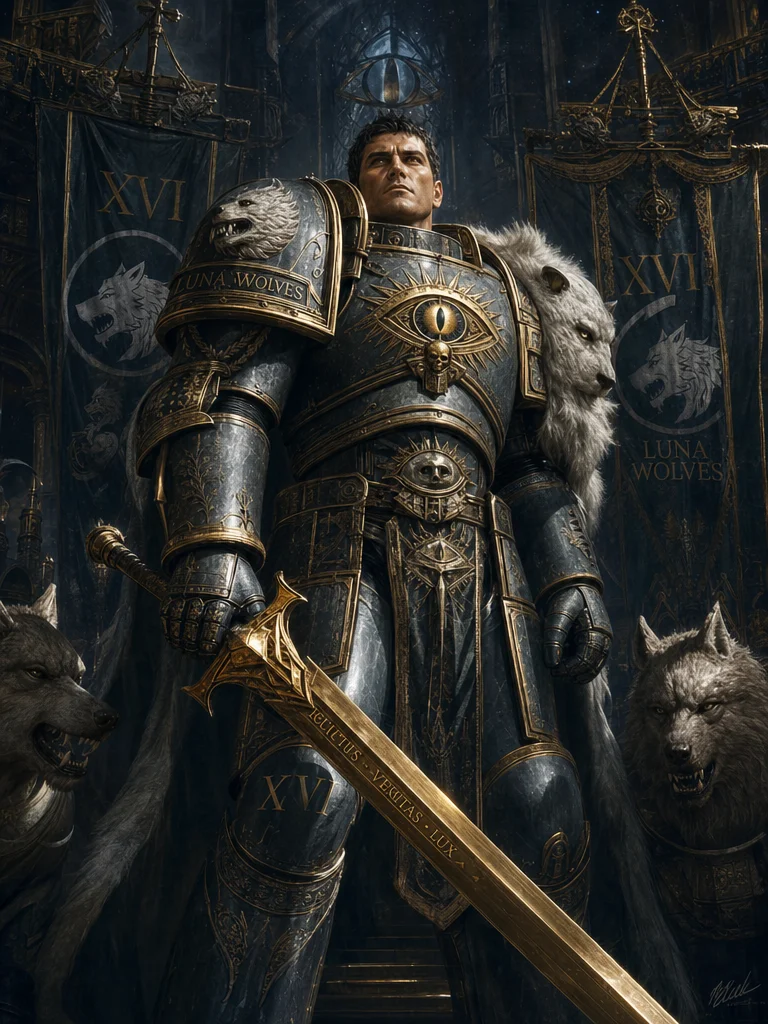
Horus Lupercal, Part I: The Warmaster
Part I of the Horus arc — from his discovery as a nameless gang-fighter on Cthonia, through thirty years as the Emperor's sole companion, the Great Crusade campaigns that made the Luna Wolves legendary, the Triumph at Ullanor, and his elevation to Warmaster. The seeds of the greatest betrayal in history are already being planted.
Before the betrayal, before the galaxy burned, there was a boy with no name on a dying world. He grew up under the surface of Cthonia, fighting in the dark. He became a Primarch. He became the Emperor's most trusted son. He became the Warmaster of Mankind — and held that rank for the most glorious decade in Imperial history. Part I of the Horus arc covers the rise: the underground gangs of Cthonia, thirty years fighting at his father's side, and a triumph at Ullanor that put him at the summit of human civilisation.
What makes Horus so compelling — and so devastating as a villain — is that his arc begins in complete sincerity. He was not a scheming opportunist. He was, by almost every account, the best of the Primarchs.
The no-name boy of Cthonia
When the Chaos Gods scattered the Primarchs' gestational pods across the galaxy, Horus drew a fortunate hand by one measure and a grim one by another. His pod came down on Cthonia, a world in the Sol System itself, close enough to Terra that the planet had already been stripped of resources and abandoned to its own entropy. 1
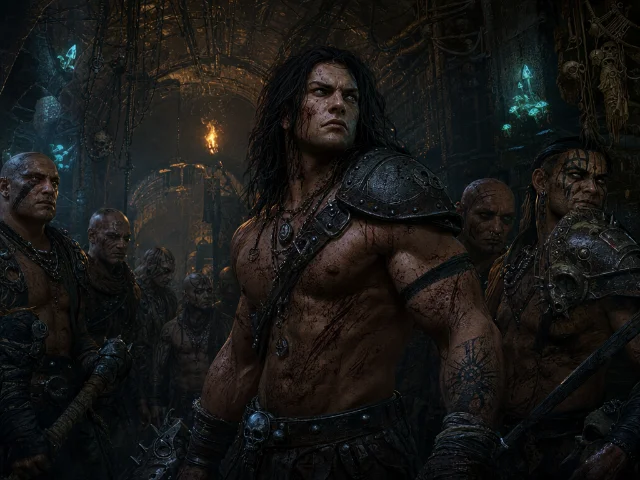
Cthonia was a hive world in decay: vast underground tunnel networks once used for mining, now carved up between brutal gang factions fighting perpetual wars over food, weapons, and territory. The child who fell from the sky was found and taken in by a gang overlord named Khageddon. He gave the boy the Mongolian-derived non-name Nergüi — "no name" — a Cthonian tradition meant to ward off misfortune. 1
Nergüi's life was gang warfare. He grew fast — faster than any human child could — and he learned to read people the way fighters learn terrain: where the weakness is, which alliance will hold under pressure, which will crack. He killed. He survived. Then, one day, he found the pod he had arrived in, now being excavated by Mechanicum Tech-Priests drawn to its anomalous readings. He attacked them, killed one, and took its weapon. His foster father's fury at the recklessness kept him from his kill-name — until the Mechanicum came in force, the chamber collapsed, and Khageddon told the boy to kill him and earn it. 1
In that chamber, the Primarch awakened. Nergüi performed the act. Buried memories flooded back — of the galaxy, of technology, of himself. His body surged with growth that no Cthonian could match. When the Tech-Priests finally broke through the rubble, a Primarch stood before them. The boy said his name: Horus. 1
Thirty years as the only son
From Cthonia, Horus was brought to Terra. The meeting with the Emperor was unlike any other Primarch reunion — because when the others were eventually found, one by one across distant worlds, there was already a relationship to inherit. Horus arrived first. He was the Emperor's only son for thirty standard years. 1
Those three decades shaped everything that followed. The Emperor trained him personally, fought beside him, trusted him with interim command of the Legiones Astartes when other duties called. Horus watched the machinery of the nascent Imperium being built from the inside. He knew how it worked. He knew the Emperor's methods and his habits. And the Emperor, in turn, knew Horus — or believed he did.
This closeness was not simply political. The two fought back to back in actual battle. At the Siege of Reillis, the Emperor saved Horus's life. Horus returned the favour on the planet Gorro, hacking an arm off an Ork warlord that had the Emperor by the throat. 1 Those were the years that formed Horus's unshakeable certainty that he was — and would always be — the Emperor's favoured son. He had earned it. It was not arrogance, exactly. It was a conclusion drawn from evidence.
When the other Primarchs began to be found, Horus adapted. He was assigned his XVI Legion — the Luna Wolves, named for Cthonia's proximity to the Sol System's moon — and given broad command authority. His first reaction to Leman Russ, the second Primarch retrieved, was sharp: he regarded the Space Wolves lord as a savage, felt a flash of what his later biographers called "hidden jealousy." 1 The Emperor wanted the brothers to get along. Horus complied, efficiently and without visible resentment. He understood the politics of it. He would always understand the politics.
The Luna Wolves at war
The Great Crusade — Mankind's two-century push to reclaim the galaxy from xenos, warlords, and old Night's chaos — was the canvas on which Horus built his reputation. 2
He was the ideal military commander for the task. Where other Primarchs excelled in specific modes — Angron's berserker fury, Perturabo's siege craft, Leman Russ's blunt aggression — Horus read the whole board. He knew which Legion to deploy against which enemy, which ground demanded attrition and which a sharp thrust. He also knew when to sheathe the sword. He was capable of turning worlds through diplomacy that a less perceptive commander would have blasted into compliance, adapting his approach to each new culture's own traditions. 2
Horus leading the Sons of Horus during the Great Crusade 1
The Luna Wolves' record was extraordinary. The Crusade ground forward across two centuries, and the XVI Legion's expedition fleets compiled a conquest tally that few could match. More than the tactical brilliance, though, Horus kept the war machine coherent. As the Emperor departed to find and reunite with successive Primarchs, he left the military coordination of the whole enterprise increasingly to Horus. The arrangement prepared him for what was coming.
The encounter with the alien Interex was characteristic. The Interex were not a backward or hostile civilisation — they had developed their own sophisticated compact with certain xenos species, a fact that placed them in conflict with the Crusade's doctrine of human supremacy. Horus handled the first contact personally, deploying the kind of patient, observant diplomacy that was his hallmark. It was during this encounter that he also exercised a rarely used right granted by the Emperor: he renamed his Legion. The Luna Wolves became the Sons of Horus. 1
That renaming mattered. In the culture of the Legiones Astartes, it was an assertion — that this Legion existed in its commander's image, that its identity was inseparable from the man at its head. Not every Primarch would have made that choice. Horus made it naturally.
The Triumph of Ullanor
In the final decades of the Great Crusade, the Imperium faced its largest single military challenge: a galaxy-spanning Ork empire centred on the world of Ullanor, the most powerful greenskin domain humanity had ever encountered. The Ullanor Crusade was the Crusade's maximum effort — multiple Legions, the Emperor himself in personal command, a campaign that chewed through years and massive casualties before the Ork Overlord's power was broken. 2
When it ended, the Triumph of Ullanor was held in the ruins of the Ork stronghold — a vast Imperial parade of the scale that had not been seen since old Terran antiquity. All surviving Primarchs attended. The Emperor arrived in golden armour. It was, by every account, the high-water mark of the Great Crusade's century-long momentum.
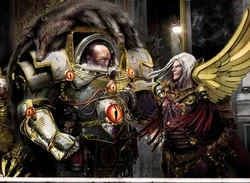
At the Triumph, the Emperor announced something else. He was returning to Terra to undertake a great secret project — its nature undisclosed — and would take no further part in the direct prosecution of the Crusade. In his place, he was elevating one of his sons to Warmaster: the supreme military commander with authority over every Legion, every fleet, every expeditionary force in the galaxy. 1
He chose Horus.
The elevation was not uncontested in spirit, even where it was accepted in fact. Angron of the World Eaters, Perturabo of the Iron Warriors, and Konrad Curze of the Night Lords each resented it, feeling that Horus's appointment diminished them or that the honour should have been differently distributed. Leman Russ and Lion El'Jonson accepted the decision but "were clearly embittered by it." Roboute Guilliman, Jaghatai Khan, and Ferrus Manus supported it from duty rather than personal enthusiasm. 1
But Fulgrim, Mortarion, Sanguinius, Lorgar, and Rogal Dorn — these brothers bowed their heads and meant it. They were the ones Horus grew closest to.
The Warmaster's court
Horus handled the aftermath of his elevation with the same political intelligence he had deployed throughout the Crusade. He sought out his resentful brothers individually, offered counsel, acknowledged their grievances without dismissing them. He used competition between the Legions as motivation, setting them against each other in a kind of measured rivalry designed to sharpen their fighting edge. 2 This worked, for a time.
The Mournival — his informal inner council of four senior Sons of Horus officers — became his sounding board and mirror. Ezekyle Abaddon, Garviel Loken, Horus Aximand, and Tarik Torgaddon each held a different relationship with their primarch, offering different kinds of counsel. Loken, the most recent inductee, was in many ways the moral counterweight — idealistic, genuinely loyal to the Emperor's stated vision of a secular empire governed by human reason. Horus found that useful. He liked being questioned by someone who believed in the work.
What he had not yet confronted was the shape of what he was becoming. The Warmaster commanded the largest military force in human history. He had more direct power than any being except the Emperor himself. And the Emperor had gone to Terra and stopped answering questions.
Seeds of a future war
The Council of Terra was the Emperor's administrative arrangement for governing the Imperium in his absence: a body of civilian officials and non-Astartes administrators given real authority over the political and economic machinery of the human domain. The Primarchs — who had spent decades conquering worlds and considering themselves the Emperor's agents — found themselves subordinated to mortal bureaucrats. 1
Horus absorbed this without visible protest. The resentment it produced, the Lexicanum notes, was "deeply buried" — and before the Heresy, "not even he truly seemed to realize existed." 1 That is the point. This was not calculated grievance being stored for later use. It was something quieter and more dangerous: the accumulation of small slights that a man who believed himself indispensable would only register as insults once someone showed him the pattern.
What Horus also did not know was that the pattern was already being drawn for him. For years, his brother Lorgar's Word Bearers — already fallen to Chaos in secret — had been quietly seeding Warrior Lodges across the Legions: unofficial fraternal networks that cut across Legion loyalty structures, creating back-channels that Horus's eventual conspirators would later use. 1 The infrastructure of the Heresy was being built inside the institution the Heresy would destroy.
Horus knew none of this. He was the Warmaster. He was at the summit of everything Mankind had built in ten thousand years of struggle. He had his Legion, his brothers, his Crusade. He was tired of the bureaucracy. He missed his father. He had questions no one was answering. And somewhere ahead on the Crusade's trailing edge, there was a feral world called Davin that the expeditionary records noted for a minor rebellion — a world that a disgraced officer named Eugen Temba had been left to govern and had instead surrendered to something ancient and foul.
The Warmaster's 63rd Expeditionary Fleet was already en route.
Part II — The Fall at Davin — will cover the wounding on Davin's Moon, the vision inside the Serpent Lodge, and the chain of betrayals that transformed the Warmaster into the Arch-Traitor.
围绕这条内容继续补充观点或上下文。