
Replit's growth playbook: $2.8M to $250M ARR in 12 months
How Replit went from near-zero revenue to $253M ARR in 12 months — using a decade-long acquisition bet on non-technical users in emerging markets, a 90-day Agent rebuild that abandoned their own model strategy, built-in infrastructure lock-in as the primary retention driver, and strategic investors (Visa, Accenture, Databricks) as enterprise distribution channels.

Eight years of near-zero revenue. Then a 90-day sprint by a ten-person team, a product launch on September 16, 2024, and one of the fastest ARR ramps in developer tools history.
Replit went from $2.8M ARR in April 2024 to $253M ARR by October 2025 — roughly a 90x increase in 18 months, and the company is now publicly targeting $1 billion in run-rate revenue by end of 2026.12 The company raised $400M in March 2026 at a $9B valuation — 3x its Series C valuation six months prior.3
The teardown below covers what actually drove each stage: a decade-long acquisition bet that most investors dismissed, a product rebuild that bet against their own model strategy, and a monetization structure that is still compressing toward high-margin SaaS while the inference costs fall.
正在加载图表…
Acquisition
Bet on the wrong buyer, at the right time
In 2016, Amjad Masad ignored every investor who told him to target professional developers, and built Replit for 13-to-17-year-olds in markets like India, Pakistan, and Nigeria. The argument: the kid running Replit in Lagos at 15 becomes the founder at 25 and the buyer at 30.4
The structural advantage that made this work was that nothing had to be installed. Replit ran in a browser tab, which meant a secondhand Chromebook in a school with no IT department could run a full dev environment. By 2021, Replit was the dominant coding platform in India and several African markets — built-in distribution into regions every other dev tool would chase years later.
This cohort of emerging-market, non-traditional developers became the exact audience Replit needed when Replit Agent launched in 2024: people who already knew the product, had low switching costs away from traditional IDEs (because they'd never used traditional IDEs), and were primed to pay for a product that could build apps through natural language.
By the time Agent launched, Replit had 22.5 million registered users with $2.8M ARR — an enormous funnel sitting on almost no monetization. The non-technical builder was the missing unlock.
The desert and the 90-day sprint
By early 2024, Replit was bleeding. GitHub Copilot was free for every Microsoft customer. Cursor had launched and was growing faster. The pro-developer audience Replit had been chasing was choosing Cursor at a faster pace than Replit could respond. Investors who had funded Replit at $1.16B (a16z led the Series B extension in April 2023) were watching Cursor outperform at a fraction of the valuation.4
In May 2024, Masad made several hard decisions: cut the team to roughly 30 people, pull 10 engineers into a stealth project to rebuild the editor and runtime for an AI agent, abandon the in-house model strategy (Replit had trained its own code model in 2023), and bet on Anthropic's Claude as the underlying engine instead. The rest of the company kept the existing product running.
The stealth team soft-launched in August 2024 to a small group — PMs at portfolio companies, designers, solo founders Masad knew. Conversion was high enough to commit to a public launch.
Agent v1: $1M ARR on day one
Replit Agent launched on September 16, 2024.5 The first-week numbers, reported publicly:
正在加载内容卡片…
- Day 1: $1M in new ARR — more than any single prior month
- Day 2: $2M ARR
- Week 1: ~$10M ARR added, more than the total base built across 8 years
- 500,000+ apps built in the first week, most by non-technical users
By December 2024 Replit was at $50M ARR. By September 2025, $150M ARR at Series C. By October 2025, $253M ARR per Sacra estimates.1
The week after launch, Masad rebuilt every team for the new user. Enterprise outbound to Fortune 500 CTOs was cut and redirected toward inbound from PMs, designers, and ops people already building on Agent. The support team was restaffed as generalists handling questions like "what is a database." The marketing site was reshot in five days around a single button: what do you want to build today? Signup conversion reportedly went from low single digits to above 12%. Every product surface was renamed in plain English: "Repls" became "Apps," "Deployments" became "Publish."4
Retention
Three layers, in sequence
Replit's retention story is not primarily about technical lock-in at the code level — it is about behavioral lock-in at the deployment level, and increasingly about organizational lock-in at the enterprise level.
Layer 1: The project graph. Every app a user builds on Replit lives in Replit's cloud. Projects accumulate context, history, and iteration state that doesn't export cleanly. Non-technical users are especially affected: they do not have local copies, version control, or the technical ability to migrate their codebase elsewhere. The app is Replit.
Layer 2: Replit's built-in infrastructure. Replit provides a built-in database (PostgreSQL with an autogenerated ORM), authentication, and one-click deployment. When a non-technical user deploys an app through Replit's built-in stack, they are not "on AWS with a Replit interface" — they are running on Replit's managed infrastructure. Sacra identifies this as the key retention signal: deploying internal apps (not just coding activity) predicts long-term retention, and Replit's integrated auth and storage creates behavioral lock-in specifically because non-engineer users are far less likely to graduate to AWS or GCP on their own.1 The gross margin improvement confirms this: Replit went from negative 14% margins in April 2025 to 23% margins in July 2025 as the revenue mix shifted from low-margin inference to higher-margin infrastructure SaaS.
Layer 3: Enterprise compliance + design systems. As Replit has moved upmarket, retention tools for larger organizations include SSO/SAML, audit logs, RBAC, SOC-2 compliance, and Design System support — the ability to ingest a company's component library into Replit's Agent so every generated app inherits the internal design language. UKG (a human capital management platform with 16,000+ employees) used this to build a reusable prototype framework that gave their product and UX teams what they describe as a 400% increase in their ability to gather customer-driven feedback before engineering investment.3
Who's actually using it
The Sacra analysis makes the ICP boundary explicit: engineering teams prefer Cursor; Replit is capturing enterprise AI spend from non-engineers — marketing, revenue ops, finance, legal — who are building customized tools that can't get on the engineering roadmap. CPQ software, training games, social listening tools, calculators-as-marketing. This is a different buyer than Cursor's buyer, which is why both can be growing simultaneously.
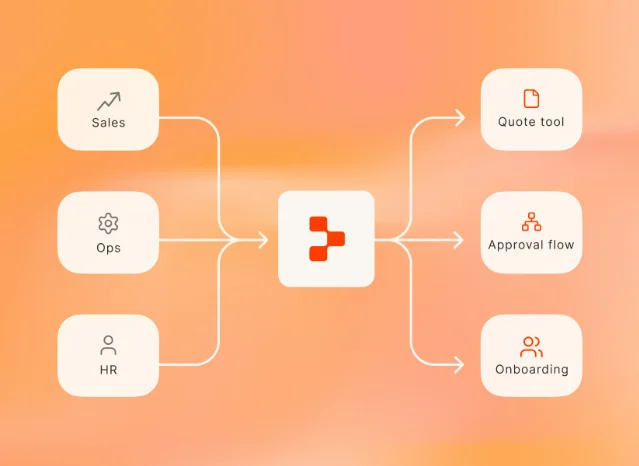
Other reported enterprise outcomes: Rokt built 135 internal applications in 24 hours; Plaid's engineering team saved 96+ hours per person; Leatherman (the tool manufacturer) saved 60% of development time; Helix Electric (construction) reported 85% efficiency gain; Musixmatch cut product launch cycles from 6 months to 2 months.
Monetization
The credit model and its four tiers
Replit's pricing runs on a credit system, where credits are a shared budget for AI Agent usage, deployments, and compute. Users buy into tiers, and credits replenish monthly.7
| Plan | Price | Monthly credits | Key limits |
|---|---|---|---|
| Starter | Free | Daily credit budget | 1 published project; public only |
| Core | $20/mo ($18 billed annually) | $20 of credits | Up to 5 collaborators, 2 parallel agents |
| Pro | $100/mo ($90 billed annually) | $100 of credits | 15 collaborators, 10 parallel agents, 28-day DB rollbacks |
| Enterprise | Custom | Custom | SSO/SAML, SCIM, RBAC, audit logs, single-tenant, VPC peering |
The self-serve enterprise cap was announced in May 2026: any organization can now purchase Replit Enterprise directly for contract values up to $200,000 with no sales engagement required.8
Expansion motion
The standard consumer path is Starter → Core → Pro. Enterprise expansion tends to happen horizontally: one team inside a company gets on Replit, builds something visible, and adjacent teams follow. Replit's customer page includes companies like Atlassian, Adobe, LabCorp, PayPal, Zillow, and Talkdesk — each of which likely started as a single-team deployment.3
ARR per employee is the metric that signals how well the expansion motion is working. Replit's ARR per employee went from roughly $50K (pre-Agent) to over $2.5M within a year of the Agent launch — almost entirely a reflection of the company's lean 30-person team structure combined with the revenue growth.4
Strategic investors as distribution
Replit's Series D investors include Accenture Ventures, Databricks Ventures, Okta Ventures, and Visa — all of whom bring enterprise customer relationships alongside capital. The Accenture partnership explicitly targets Replit's deployment into Accenture's global enterprise client base.9 Visa's 1,000-employee internal deployment preceded its investment — standard enterprise reference customer logic — and the payment integration makes Replit apps that need to transact easier to build.8
Databricks' role is potentially the most significant for retention: their Lakebase integration and Databricks Apps partnership means Replit apps can connect directly to enterprise data warehouses, with Databricks-managed governance. That is a meaningful pull for enterprise data teams who currently need to involve engineering to access their own data.3
Takeaways
1. The ten-year acquisition flywheel is a structural moat. Replit spent 8 years building distribution into markets and user segments that competitors structurally can't enter retroactively. The teenager in Lagos in 2017 is not a metaphor — she is a real user who was already Replit-native when the Agent launched. No competitor can replicate that cohort, because the timeline doesn't allow it.
2. Abandoning your own model is a growth decision, not a technical one. Replit had trained its own code model in 2023 and had the infrastructure to keep building it. The decision to drop the model and bet on Anthropic instead removed a significant engineering drag and let the Agent team ship faster. Product companies that hold onto infrastructure differentiation past its useful point pay a speed tax that compounds.
3. Deployment lock-in is stickier than code lock-in. Replit's strongest retention signal is not that users wrote their code inside Replit — it is that they deployed apps using Replit's built-in database and auth. A user whose app runs on Replit's managed infrastructure faces a real migration cost. A user who just typed code into an IDE faces almost none. The implication: if you are building a dev tool and want retention, push toward hosting and infrastructure, not just editor features.
4. Non-technical buyers expand faster than technical ones. The key insight behind Replit's ICP flip is not that non-technical users are more loyal — it is that they are less price-sensitive and more likely to pull in adjacent teams. An engineer on a personal plan stays on a personal plan. A marketing ops manager who builds something that solves a real workflow problem goes to their VP and creates a team account. That expansion path is what makes the enterprise motion work without a large sales team.
参考来源
- 1Sacra: Replit at $253M ARR growing 2,352% YoY
- 2Business Insider: Replit Projects $1B Revenue by End of 2026
- 3Replit blog: Series D announcement, March 2026
- 4Startup Riders: Replit's Growth Playbook
- 5Replit blog: Introducing Replit Agent
- 6Replit Customers page
- 7Replit Pricing page
- 8PR Newswire: Replit Visa partnership announcement
- 9Accenture newsroom: Accenture Invests in Replit
围绕这条内容继续补充观点或上下文。