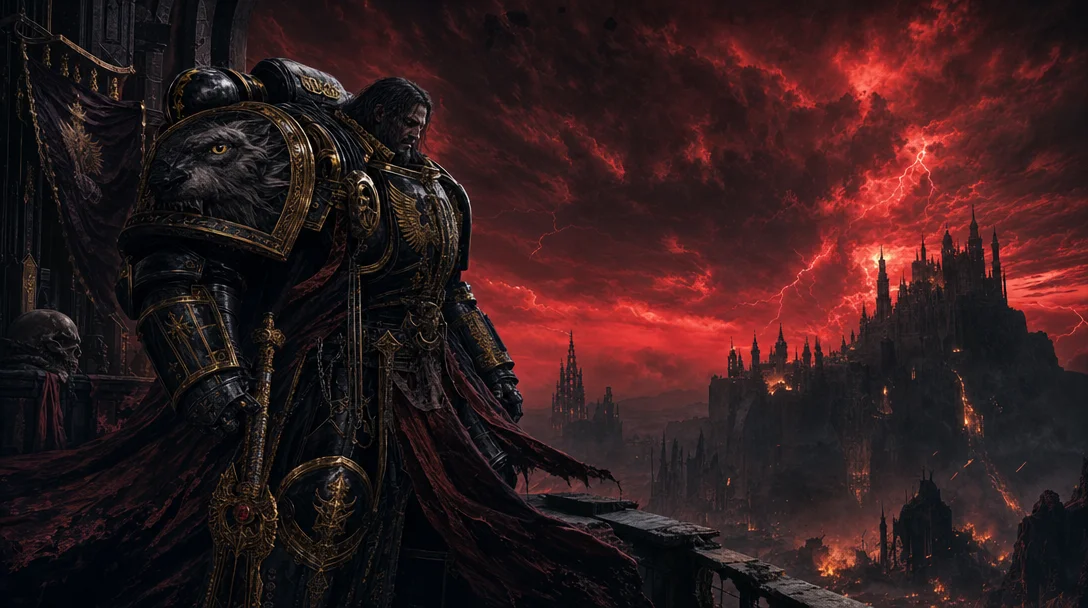
Horus Lupercal, Part III: The Throne of Ruin
The final chapter of the Horus arc — from the secret he stole at Molech and Leman Russ's doomed gambit with the Spear of Russ, through the Solar War, the Siege of Terra, the death of Sanguinius, and the Emperor's last mercy to his fallen son, to Abaddon's destruction of the Horus clone at the Battle of Harmony and the birth of the Black Legion.
Previously: Part I traced Horus from Cthonia's gang warrens through thirty years as the Emperor's right hand to his elevation as Warmaster. Part II covered his corruption on Davin's Moon, the manipulation of seven Primarchs, the Burning of Prospero, the virus-bombing of Isstvan III, and the Drop Site Massacre that destroyed three Loyalist Legions. Now, the final act.
The secret of Molech
Before Horus could march on Terra, he needed to understand something his father had kept hidden for decades. The clue surfaced only after a failed assassination attempt by Shadrak Meduson at the Battle of Dwell: the violence jarred loose a memory the Emperor had deliberately erased from his son's mind. 1
The memory pointed to Molech — a feudal world the Emperor had visited during the Great Crusade, a world he had guarded with an entire Knight House and four Space Marine Legions far in excess of anything that unremarkable planet could justify. Horus invaded it. 1
What he found inside was a gate: a warp portal the Emperor had used to enter the Immaterium, bargain with the Chaos Gods, and steal from them the raw power he needed to create the Primarchs. Horus walked through the same gate. In the Materium, only moments passed. Inside the Warp, he conquered for what seemed like an eternity — winning a thousand kingdoms, amassing billions of daemonic followers, defying gods. He emerged with the Emperor's own stolen power now his own, and the process had visibly aged him. He had chosen to take that power by sheer force of will rather than through deception, as his father had. And unlike the Emperor, he refused a throne in the Immaterium; he walked back out into the physical universe to use what he had taken. 1
Horus emerged from Molech as something that no longer fit cleanly into any category. He was still, technically, a Primarch — flesh and blood, capable of dying. But he channeled warp power on a scale that blurred the line between commander and deity.
Horus leads his rebellion, M31 1
The wolf who didn't finish the kill
Leman Russ of the Space Wolves had watched the Heresy unfold from a position of gnawing frustration. He had helped trigger the Burning of Prospero — a trap Horus had baited — and now Terra was being strangled one system at a time. When the Knights-Errant secretly planted tracking runes aboard the Vengeful Spirit during the Battle of Molech, Russ saw his chance.
He stopped first at Fenris, where a vision during an archaic ritual revealed to him both the true nature of the Spear of Russ — a weapon the Emperor had made and imbued with his own power — and something darker: the nature of Russ's own existence and purpose. Whatever he saw on Fenris, it resolved him. He announced his intention to wound Horus before the Siege of Terra, knowing full well that victory was beyond reach. None of his Space Wolves refused to follow. 2
The fleet of the Sixth Legion tracked the Vengeful Spirit to the Trisolian System in 012.M31, where Horus's armada was overseeing a Mechanicum surrender. Russ navigated through the electromagnetic interference between two of the system's lesser stars — destroying several of his own ships in the process but buying six and a half hours of concealment. When his fleet finally emerged from cover, it had only three hours before the traitors could respond. 2
The Hrafnkel drove straight into the Vengeful Spirit at point-blank range. Before the flagship's void shields were even fully down, a boarding force of thousands of Space Wolves rammed through its hull. Russ himself landed aboard in his personal Stormbird. The ship fought back — rearranging its corridors, setting its possessed architecture against the intruders. Space Wolves, Bjorn among them, carved their way to the Warmaster.
Horus and Russ clash aboard the Vengeful Spirit, 012.M31 1
What followed was one of the most consequential duels of the entire Heresy. Horus, swollen with the power of Molech, dominated the fight — but the Spear of Russ cut through his sorcerous defenses. Russ took grievous wounds from the Talon of Horus, his armour torn away. He broke free of his ruined plate, drove the Spear into Horus's side, and then — hesitated.
Through the wound, for the first time since before Davin, Russ saw his brother. Not a creature of Chaos. Horus Lupercal, cleansed momentarily of corruption by the Spear's power. 2
He didn't deliver the killing blow.
Horus recovered and nearly killed him. Only the sacrifice of hundreds of Space Wolves piling onto the Warmaster — and eventually the sacrifice of Grimnir Blackblood himself — gave Bjorn enough time to drag Russ back to the Hrafnkel. Knight-Errant Bror Tyrfingr's squad was wiped out by Abaddon's Justaerin in the bowels of the ship. Several Great Companies lost four-fifths of their strength. The Space Wolves, for all practical purposes, ceased to exist as a Legion. 2
Horus won. But the wound did not close.
The long road to unconsciousness
The Spear of Russ proved more durable than any blade. Months after Trisolian, at the Battle of Beta-Garmon — the last major engagement before the Solar System — the wound reopened. Horus collapsed into a coma-like state. The Chaos Gods, squabbling over the soul of their champion, were literally tearing apart the fragment of his spirit still trapped in the Molech gate. 1
Without Horus, the traitor war machine started coming apart. Fulgrim ignored summons. Angron refused them. Mortarion would only take orders from the Warmaster personally. The Sons of Horus tore themselves apart in factional squabbles between Horus Aximand and Falkus Kibre. Maloghurst, the equerry, kept it all from collapsing entirely.
It took a blood ritual — Maloghurst descending into the Warp and finding Horus on an eternal battlefield, still fighting, still believing he was on Molech — to drag the Warmaster back. The second attempt cost Maloghurst his life: he stabbed Horus through the old wound and gave his own soul to complete the ritual. Horus woke, took command, and arrived on Ullanor to convene the Traitor Primarchs for the final push. 1
He also dealt with Lorgar, who had used the coma to build a case for replacing Horus as Warmaster. Horus knew about the coup attempt — the prophetess Actaea had warned him — and beat Lorgar nearly to death before exiling him. What Lorgar said as he left was haunting: he did not curse Horus. He pitied him. By this stage, the form of Horus Lupercal was flickering between his Luna Wolf appearance, his Warmaster form, his Molech-ascended state, and what could only be described as a dark maw of Chaotic energy. Zardu Layak, who had been watching closely, told anyone who would listen that the Chaos Gods were burning Horus out and he had limited time left to live. 1
The Solar War and the shadow in Lupercal's Court
The traitor armada arrived in the Sol System in what became known as the Solar War. Horus himself was notably absent from the initial engagement — neither he nor the Vengeful Spirit appeared — which left Rogal Dorn and Malcador puzzling over his true intentions. Their answer came when Ahriman and the Word Bearers aboard a vessel called The Comet performed a ritual that tore open a massive warp rift directly over Luna. Through it poured tens of thousands of warships. The Vengeful Spirit was at their head, with Horus commanding from Lupercal's Court. 1
The Solar defenses collapsed. As his fleet strangled the Materium, the Chaos Gods assaulted the Imperium in the Immaterium — and it was the Emperor, alone on the Golden Throne, who held back those tides from the Sol System. Horus taunted him psychically, appearing as a feral wolf, declaring him a tyrant. The Emperor didn't respond to the taunts. He looked past his son and addressed the Ruinous Powers directly, rejecting them, denying their puppet. As the Emperor's psychic fire dimmed — the cost of holding back what was coming — Horus gloated that his only option left was to run. 1
During the Siege itself, Horus was almost entirely absent from direct command. Abaddon, watching from the outside, grew increasingly disgusted: Horus spent his time sealed inside Lupercal's Court with Zardu Layak's Word Bearers, falling into trance states, scanning the Empyrean for lore, fighting the Emperor on a psychic battlefield within the Warp. He commanded through fear rather than inspiration. He was showing signs of senility — calling his current equerry Argonis by Maloghurst's name, reliving past glories as if they were happening in real time. Much of the siege's day-to-day planning fell to Perturabo. 1
Perturabo, eventually, walked out. When Horus ordered him to sacrifice the Legio Mortis at the Mercury-Exultant Kill-Zone regardless of the cost — "because I will it so" — and then dispersed the Iron Warriors across the front lines and replaced Perturabo's command position with Mortarion, the Iron Lord simply left the war. 1
The trap
With Guilliman's relief fleet nine hours away, Horus finally made his move.
He ordered the Vengeful Spirit's void shields lowered.
The message was clear: come aboard. A direct invitation to the Emperor. Horus's calculation was brutal: kill the Emperor before Guilliman arrives, and Guilliman's fleet loses heart and scatters. The Siege was lost anyway without a decisive stroke, and Horus was still confident in the one-on-one kill. 1
The Emperor took the bait. He teleported aboard the Vengeful Spirit with Rogal Dorn, Sanguinius, Constantin Valdor, and their escort. Horus sprung the trap immediately: using his warp-bond to the flagship, he scattered the loyalists throughout the vessel, turned the Emperor's own Custodian Guard against their master, and trapped Rogal Dorn in a psychic desert he would experience as centuries of madness. 1
He had been concealing his true power. All of it.
The final confrontation between Horus and the Emperor, M31 1
The death of Sanguinius
Sanguinius reached Horus first.
The Angel was already wrecked: he had battled through the corrupted vessel, fought the Greater Daemon Ka'bandha to near-death, and borne the weight of prescient visions that had haunted him for years. He knew he was going to die here. He had seen it.
Horus didn't want to kill him. He offered the Angel a place at his side — they would face the Emperor together, expose his lies together, build something new together. Sanguinius refused without hesitation. 3
What followed was a purely martial duel by Horus's choice — he held back his warp power and fought Sanguinius as Primarch against Primarch, hoping to grind him down until he broke and accepted the Chaos powers rather than death. Sanguinius was ferocious. He took wounds that should have stopped him. He kept fighting. He opened cuts on Horus's armor that no one had managed since Trisolian. He was stubborn enough and vicious enough that Horus actually grew frustrated, and the frustration cracked his patience. When Horus sensed the Emperor approaching, he abandoned the plan. 1
He reached into the 8th dimension, grabbed Sanguinius mid-flight, slammed him to the deck, beat him with Worldbreaker, and impaled him multiple times with the Talon of Horus, before the skull of Ferrus Manus that Horus had mounted in his throne room. When Sanguinius was dead, Horus let out a disappointed sigh. The daemons strung his brother's body up. 1
The psychic shockwave of Sanguinius's death swept across Terra and the Sol System, shattering the minds of Blood Angels scattered across the siege. It would leave a permanent scar in the genetic memory of every Blood Angel for ten thousand years to come.
Father and son
The Emperor arrived.
Rather than address Horus directly, he spoke past him to the Chaos Gods assembled to watch. He rejected them. He refused to become the Dark King — the fifth god that Actaea's visions had shown gathering strength as the crisis reached its peak. In this, paradoxically, Horus and his father were both refusing ascension: Horus had refused a throne in the Warp at Molech; the Emperor refused one now at the cost of everything. 1
Fully empowered by all Four Chaos Gods simultaneously, Horus overwhelmed the Emperor in a battle that transcended space and time and spread across multiple dimensions. He nailed his father's broken but still-living body to a fifth throne he had built alongside those of the Ruinous Powers, declaring that he was now a god and would keep the Emperor as a puppet-slave. 1
Then Garviel Loken appeared.
The former Mournival member — one of the four voices who had once counselled Horus on all things — had survived the Heresy as a Knight-Errant. He pointed out what was actually happening: the Emperor had refused to drink from the Warp and become a god. Horus was the one being controlled by the Chaos Gods. And Horus, in his arrogance, was a slave — the very thing he had been raging against his entire rebellion.
Loken appealed to Horus's pride. If Horus was truly superior, let him finish the Emperor as a Primarch, not as a vessel stuffed with borrowed daemonic power. 1
Horus, perhaps certain of the outcome either way, agreed. He stripped away the Chaos powers and crushed the Emperor's skull with Worldbreaker — and the Chaos Gods and daemons around him screamed warnings he ignored.
The corpse and Garviel Loken had both been illusions. The real Emperor was still alive, and the moment Horus cast off his warp armor was the moment the Emperor had been waiting for.
The mercy
What exactly passed between them in those final seconds is not entirely known. The Emperor used the reactivated Astronomican to shine its light directly into Horus's mind. Without his Chaos-given protection, Horus felt the agony of it. He tried to cloak himself in warp power again. The Chaos Gods, teaching their disobedient slave a lesson, refused to answer. 1
In the brief window when the corruption was absent, the old Horus surfaced. The one who had fought back-to-back with his father for thirty years before any of the rest of them were even found. The one who had genuinely believed, before Davin, that what he was building was worth building.
He pleaded with the Emperor to kill him before the Chaos Gods reasserted their grip.
The Emperor hesitated. Then, using the Athame blade that Ollanius Persson — a mortal soldier who had died for the attempt to protect his Emperor — had pressed into his hand, he drove it through his son's chest. He channelled everything remaining into the blade. 1
Horus's form was obliterated. What remained was a skeleton in charred armour, watched over by the real Garviel Loken, who was heartbroken.
The Emperor himself would never walk again. Mortally wounded, he was interred in the Golden Throne — kept technically alive by a machine built to sustain his soul across the Warp, consuming a thousand psykers a week, never recovering, never truly dying. The Astronomican kept shining. He never spoke again.
After the fire: the fate of a corpse
Abaddon took command of the Vengeful Spirit and ordered the retreat into the Eye of Terror. Horus's body was taken with them, placed on display in a temple on the fortress world of Maeleum, where the Sons of Horus revered their gene-father even in death. The daemons of the Warp, by contrast, did not revere him. They remembered him as the Sacrificed King — the one who had come closest to breaking everything, and had been broken in turn. 1
The inter-traitor wars that followed — the Legion Wars, the Eye of Terror Slave Wars — tore the remnants of the XVIth Legion apart. The Emperor's Children raided the Sons' fortress on Maeleum and stole Horus's corpse. Fabius Bile, Progenitor of the Emperor's Children, used it to clone him. Not once. Multiple times. He grew adolescent clones of all twenty Primarchs. 4
Falkus Kibre, former Justaerin captain, hunted through the Eye to find Abaddon — who had been wandering alone in the warp for years following the collapse of the Sons. With the help of the World Eaters' Fifteen Fangs and the Thousand Sons' Ka'Sherhan warbands, Kibre located a psychic trace that led to the Vengeful Spirit deep inside the Eleusinian Veil. Abaddon had not been hiding; he had been waiting, already assembling the force he needed.
He sailed for Harmony. 4
The Battle of Harmony
The planet Harmony was home to Canticle City, the Emperor's Children fortress where Fabius operated. Abaddon's tiny force — barely thirty Black Legionaries, the Vengeful Spirit crewed by Thousand Sons psykers, and a handful of allied ships — was outnumbered twenty to one. He declared his new Legion as they approached: the Black Legion, armour painted black to bury the shame of Horus's name and start fresh. First, though, they would give Horus a dignified death.
The Thousand Sons psykers crashed the warship Tlaloc directly into Canticle City. The impact shattered what remained of the Emperor's Children's cohesion, and their remnants began fleeing the planet. Abaddon boarded Fabius's laboratory ship, the Fleshmarket, and fought through abominations and enhanced warriors until he found Fabius's chamber: adolescent clones of all twenty Primarchs, grotesquely mutated, still growing. 4
Then Fabius released the Horus clone.
The clone wielded Worldbreaker. He was confused and forgetful — whatever passed for memory in something grown from a dead man's gene-code — but still a killing machine. He tore through Black Legionaries until Abaddon drew his attention by showing him the Talon of Horus, which Abaddon now wore.
The clone came at him in a rage.
Abaddon caught Worldbreaker with the Talon and crushed it. He impaled the clone. In its dying moments, the clone remembered who Abaddon was and called him his son. 4
Abaddon answered that he was his son no longer.
Fabius retreated. The surviving Emperor's Children scattered into fractured hedonistic warbands. Some even bent the knee to Abaddon outright. The former Sons of Horus, reforged into the Black Legion, became the largest and most dangerous of the Traitor Legions — not united around a father's name, but around Abaddon's own will. He would go on to lead thirteen Black Crusades against the Imperium over ten thousand years, always carrying the Talon that had once belonged to Horus. 4
Legacy: what Horus actually changed
Horus didn't win. He also didn't lose in the way his enemies would have liked.
His primary goals — killing the Emperor, destroying the Imperium, ascending to power beyond any Primarch — all failed. The Emperor lived, in the most technically-correct sense of the word. The Imperium survived, battered and militarized in ways it hadn't been before the Heresy. And Horus himself was destroyed so completely that the Chaos Gods couldn't even reconstruct his soul: they tried, and failed. He is genuinely gone.
But the Imperium that survived the Heresy was not the one the Emperor had been building. The vision of a rational, secular humanity growing beyond the Age of Darkness was effectively over. The Imperial Creed, the absolute authority of the High Lords, the Inquisition, the Second Founding of the Adeptus Astartes — all of it grew from the trauma of betrayal. The Emperor's abandonment of active leadership, replaced by ten thousand years of bureaucratic theocracy, is in its own way Horus's most enduring victory: he did not build the thing he fought for, but he guaranteed that his father could not, either.
The daemons called him the Sacrificed King, and that title is more accurate than they perhaps intended. Horus was the offering. Not to the Chaos Gods, who played him and then discarded him, but to the shape of the future: a grimdark universe in which the only question left is how long the candle holds against the dark.
Next in the Character Chronicles: Abaddon the Despoiler — First Captain, successor, and the man who chose to be more than a monument to someone else's failure.
Horus Lupercal, Part I: The Warmaster | Part II: The Wound That Broke the World
이 콘텐츠를 둘러싼 관점이나 맥락을 계속 보강해 보세요.