
The outdoor museum Nashville built for its birthday

The outdoor museum Nashville built for its birthday

Bicentennial Capitol Mall State Park — a 19-acre outdoor museum in downtown Nashville modeled on the National Mall — draws 2.5 million visitors a year and holds the distinction of being Tennessee's most-visited state park. The article traces its story from French Lick Creek and "Hell's Half Acre" through the 1995 political near-cancellation (saved by Bob Corker and Howard Baker in a bipartisan intervention), to the park's extraordinary density of monuments, a 95-bell carillon, a granite map you can walk on, a live railroad trestle painted white, and buried time capsules whose scheduled opening date is 2096. Wikipedia selected it as the Featured Article for May 31, 2026.

Wikipedia Featured Article
2026/5/31 · 8:15
購読 2 件 · コンテンツ 3 件
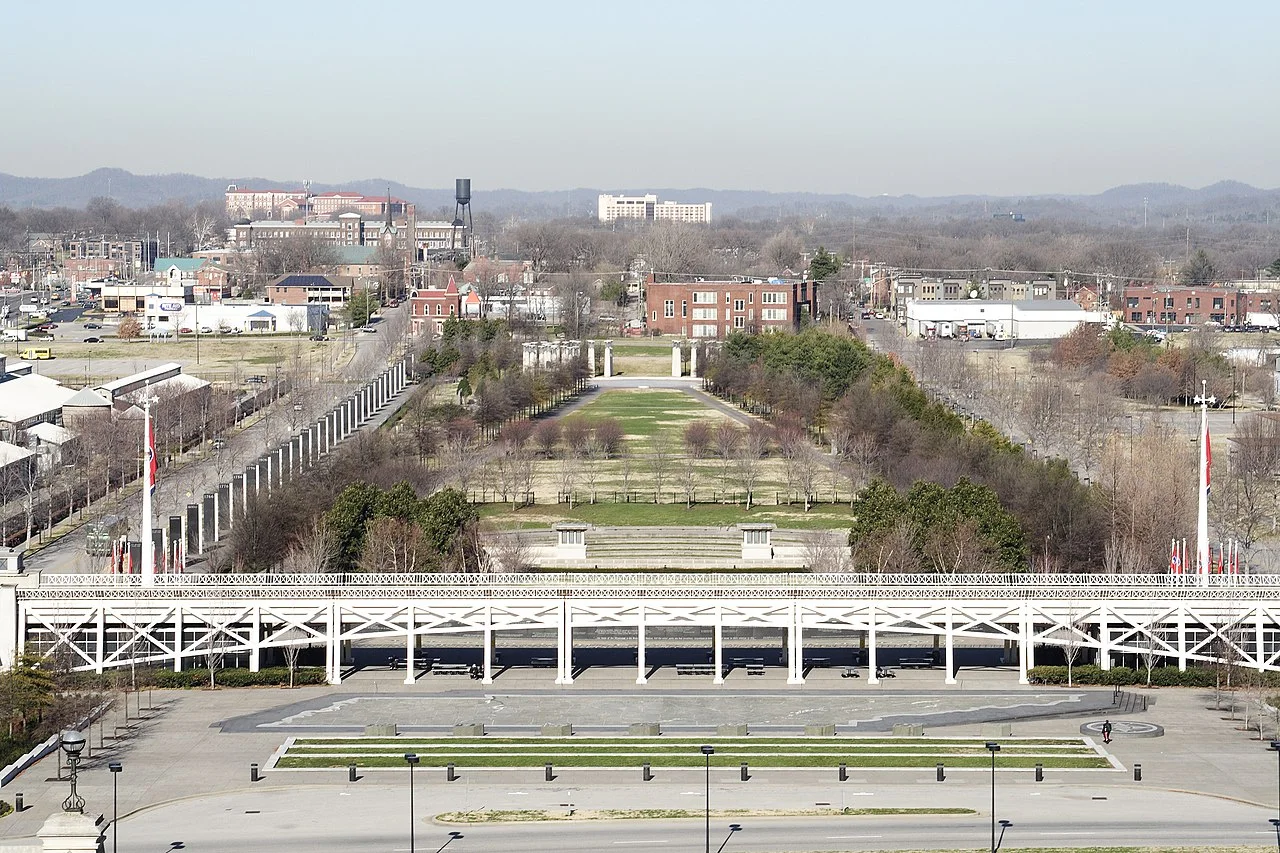
Stand at the south end of Bicentennial Capitol Mall State Park on a clear morning and you can see the Tennessee State Capitol filling the sky at the top of a long, landscaped corridor. Between you and that domed building lies 19 acres of green granite, cascading fountains, ringing bells, buried time capsules, and more historical information than most people can absorb in a single visit. 1
The park sits in the heart of downtown Nashville, bordered by Jefferson Street to the north and James Robertson Parkway to the south. It opened on May 31, 1996 — one day before the 200th anniversary of Tennessee's statehood — and was designed as an outdoor museum in the tradition of the National Mall in Washington, D.C. 1 Today it draws more than 2.5 million visitors a year, making it the most visited of Tennessee's 61 state parks and one of the most visited public spaces in Nashville — a remarkable outcome for a park that was nearly canceled, finished over budget, and initially received with something close to indifference. 1
Today, Wikipedia's editorial community selected it as the site's Featured Article.

Buried before it bloomed

The land the park occupies has a long memory. French Lick Creek — also called Lick Branch — once flowed through the site's southern portion, carrying salt licks and sulfur springs that drew bison, deer, turkey, and bears, and that made the area a significant hunting ground for Cherokee, Chickasaw, and Shawnee peoples. 1
The first European presence came in 1714, when French traders under Charles Charleville built a trading post near the springs — predating Nashville by more than six decades. 1 Settlers from East Tennessee arrived in 1779, drawn by the same springs, and founded Fort Nashborough along the Cumberland River. German immigrants moved south of the creek in the 1830s, creating a neighborhood called Germantown; the area flooded regularly.
The creek's fate was grimmer. By the mid-19th century it had become contaminated with garbage and raw sewage; in 1873 it was credited with spreading a cholera epidemic that killed more than 1,000 people. 1 The city channelized the creek in 1889, then buried it entirely in a brick sewer tunnel 25 feet underground. The neighborhood above it became a red-light district — locals called it "Hell's Half Acre."
By the 1950s, a large-scale urban renewal project funded by the Housing Act of 1949 had demolished most of the structures in the area. 1 What had been a trading post, a German immigrant quarter, and a red-light district became a flat, underused expanse of land just north of the capitol. That expanse is what someone would eventually turn into a park.
リンクプレビューを読み込んでいます…

A sketch on a napkin

The idea came from John Bridges, an employee at Nashville-based Aladdin Industries. In 1988, he recalled the unobstructed view of the Tennessee State Capitol from a long-gone building called the Elliott School and sketched out what a public park on that sight line might look like. He showed the sketch to Aladdin's CEO, Victor S. Johnson Jr., who passed it to Governor Ned McWherter in 1989. 1
McWherter was initially skeptical. He reportedly called the project "Hall's Mall," a dry reference to state planning director James E. Hall. But he came around quickly — and on July 19, 1989, he publicly announced plans to convert the land into a linear green space for Tennessee's upcoming bicentennial. In doing so, McWherter suggested the park could also serve as a gesture of reconciliation to African American communities in North Nashville, whose Jefferson Street neighborhoods had been decimated by the construction of Interstate 40 in the 1960s. 1
Planning moved steadily forward through the early 1990s. A Bicentennial Commission of 23 members formed in June 1992. Architects Tuck Hinton, engineers SSOE, and landscape architects Ross/Fowler were hired in August 1992. 1 They settled on a theme — "the land, the people, and the music of Tennessee" — and unveiled a master plan at Fisk University in June 1993.
Then, in January 1995, construction nearly stopped. The newly elected Republican governor, Don Sundquist, moved to halt the project over escalating costs and, reportedly, his irritation that McWherter had appointed then-Vice President Al Gore as honorary co-chair of the bicentennial commission. 1 What saved the park was a quietly bipartisan intervention: Finance Commissioner Bob Corker — later a U.S. senator — advised Sundquist against killing it. Former U.S. Senator Howard Baker and Republican donor Ted Welch also encouraged Sundquist to let it proceed. Sundquist relented, and went further: he urged that the dedication ceremony be opened to the public rather than limited to legislators and donors. 1
Journalist and author Keel Hunt would later write that the bipartisan partnership that saved the park embodied "how bipartisanship brought Tennessee to the twenty-first century and could save America." 1
Groundbreaking was June 27, 1994, with an initial cost estimate of $23 million (about $44 million in 2024 dollars). By October 1994 the project was already over budget. Final construction cost came to $51 million — roughly $93.9 million in 2024 dollars. 1 The park opened at 8 a.m. on May 31, 1996. The next afternoon, Sundquist, McWherter, Nashville Mayor Phil Bredesen, Al Gore, and Postmaster General Marvin Travis Runyon gathered in the amphitheater to unveil the Tennessee Bicentennial postage stamp. On June 1 — Tennessee's actual 200th birthday — the formal dedication ceremony included a poem by state poet laureate Margaret Britton Vaughn, a cannon salute by the Tennessee National Guard, and fireworks over the capitol.

The map underfoot

The centerpiece of the park's southern section is the Tennessee Map Plaza, a 200-by-50-foot slab of green granite that functions as an extraordinarily literal map of the state. 1 City and county names are cut into the stone with pigmentation scripts. Rivers are polished to a higher sheen, producing a shimmer visible from above — the surface was deliberately designed to read the way Tennessee looks from an aircraft. Interstate Highways run in gold pinstripes. The map is slightly tilted to improve visibility from Capitol Hill above.
Each county seat contains a flush-mounted light that turns on at night. The original system consumed over 3,000 watts; in 2019 the lights were upgraded to solar-powered LED luminaires. 1 Below the main map, eight smaller granite maps illustrate the state's geology, original inhabitants, territorial history, transportation network, land cover, recreational opportunities, musical heritage, and topography.
Directly south of the map, a 300-foot steel railroad trestle carries the CSX Transportation mainline across the park. 1 The trestle was one of the most logistically demanding elements of the construction, requiring constant coordination with CSX officials. It was painted white to reflect light beneath it. The limestone bridges at each end echo the Greek Revival style of the State Capitol, with abutments inscribed "1796" and "1996." Flanking each end, a 12-by-18-foot Tennessee flag flies alongside eight smaller flags — the large flags mark the bicentennial, the small ones represent Tennessee as the 16th state. The flag placement was inspired by André Le Nôtre's landscaping at the Palace of Versailles. 1 Visitor facilities — restrooms, picnic tables, a small visitor center — are tucked underneath.

Rivers, bells, and three stars

Walk north from the trestle and the park opens into its most theatrical section. The Rivers of Tennessee Fountains — 31 geyser-like jets representing each major river and waterway in the state — erupt from the ground at various heights, lit by color-changing lights after dark. 1 In summer they function as a splash pad; in any season the curved wall behind them, inscribed with facts, quotes, and poetry about Tennessee's waterways, is worth reading. The wall's shape alludes to the Tennessee River's dramatic bend through the state — the origin of Tennessee's old nickname, "the Big Bend State." Water from all 31 fountains flows into a large trough representing the Mississippi River, which drains almost all of the state's watershed. 1
The fountains have had their share of problems. Sunscreen residue from splash pad users repeatedly clogged the pipes; they were replaced in 2001, then restored again between 2006 and 2007. A new enhancement project launched on February 23, 2026 to refurbish the fountain system and upgrade the park's electrical infrastructure. 1
Behind the river displays, a 2,200-seat Tennessee Amphitheater descends into the ground, patterned after the Ancient Theatre of Epidaurus in Greece and the Roman Theatre of Orange. 1 Seating is terraced lawn, each step seven feet wide. The stage is flanked by twin towers designed to look like large lanterns; their speaker openings are stainless steel replicas of the tri-star logo from the Tennessee state flag. The below-grade location, combined with shade trees, was intended to improve acoustics and muffle urban noise.
At the center of the park stands the Court of Three Stars — a circular plaza of red, white, and blue granite arranged into a large version of the Tennessee state flag's three-star emblem. 1 The three stars represent the three Grand Divisions of Tennessee — East, Middle, and West — geographic, cultural, and economic divisions defined in state law.
Surrounding the plaza, 50 white columns house a 95-bell carillon, one bell for each of Tennessee's 95 counties. 1 The columns are positioned for surround-sound effect; at the top of each hour the carillon plays an arrangement of "Tennessee Waltz," followed by a time-chime on the largest bell in middle C. Throughout the day it cycles through portions of "Ol' Man River," "Chattanooga Choo Choo," "On Top of Old Smokey," and "Rocky Top." A narrow path encircling the court is inscribed with the names of prominent Tennessee musicians, with space reserved for future additions.
The carillon was not in the original construction budget. It was deferred in March 1995 due to cost overruns and only completed in July 2000. 1 A 96th bell — the Answer Bell — sits in a separate tower on Capitol Hill and joins the carillon at the top of each hour, representing the government's commitment to the people. Its tower was inspired by the Choragic Monument of Lysicrates and the Tower of the Winds in Athens. The octagonal granite base features sculpted figures called "musicks" — female angels representing Tennessee's major music genres — designed by artist Paul Harmon. The Answer Bell was dedicated on June 1, 2003, completing the original design vision seven years after opening day. 1
リンクプレビューを読み込んでいます…

Two paths converging

The park's two outer walkways carry the deepest layers of information.
Along the eastern edge, the Walkway of the Counties runs the full length of the park, representing Tennessee's geography from west to east. 1 The planters along it are topographically literal: the West Tennessee section is at ground level, flat and low; Middle Tennessee rises with stone walls; East Tennessee is marked by mounds representing mountains. Granite obelisks describe the state's nine physiographic regions. At the midpoint, fragments of the original Tennessee State Capitol columns are displayed in a structure called the Charles Warterfield Reliquary, dedicated in August 1999. 1 From each of Tennessee's 95 counties, a time capsule is buried beneath the walkway, arranged by Grand Division — all to be opened on June 1, 2096, Tennessee's tricentennial.
Along the western edge, the Pathway of History — officially named the Andrea Conte Pedestrian Walkway after Tennessee's First Lady from 2003 to 2011 — is a 1,400-foot series of four-foot-tall granite walls chronicling Tennessee's entire history. 1 It begins in prehistory, one billion years ago, and runs in 50-foot increments of decades, each marked by a large granite pylon inspired by the monoliths from Stanley Kubrick's 2001: A Space Odyssey. 1 Cracks and shifts in the wall's construction were deliberately designed to represent political division during the Civil War. A single misspelling of "ratifying" on one of the panels — present at opening — was later corrected.
Between these two outer paths run the Pathway of Volunteers, two inner walkways, each 1,400 feet long, built from 17,000 individual pavers inscribed with the names of donors who funded construction. 1 The name references Tennessee's historical identity as "the Volunteer State," earned when Tennessee sent more than its requested quota of soldiers during the War of 1812 and cemented during the Texas Revolution and Mexican–American War.
The two inner walkways begin far apart at the south end and gradually converge until they nearly touch at the Court of Three Stars in the center. Keel Hunt has argued that the convergence was always meant to represent something political: the bipartisanship between Democratic Governor McWherter and Republican Governor Sundquist that made the park possible. 1 Architect Kem Hinton noted that the park's designers simply believed "the park had to be a destination itself" — and that merely building a green space would not be enough to establish the site as a true civic landmark.

Monuments to the dead

Several memorials occupy the park's central lawn and edges, some of them conceived after the original design was complete.
The WWII Memorial was not part of the original plan. State Architect Mike Fitts conceived it after opening and persuaded the Tennessee WWII Memorial Foundation to fund it. It broke ground on July 1, 1996 — just one month after the park opened — and was dedicated on November 11, 1997. 1 Ten pillars etched with images of the war ring a rectangular plaza: the eastern pillars covering the European and Mediterranean theaters, the western covering the Pacific. At the center, an 18,000-pound granite globe suspended on a water film — fabricated in Germany — maps the world of the 1940s, with lines connecting Tennessee to major battle sites. 1 The plaza surface contains gold stars honoring the 5,731 Tennesseans who died in WWII, and a bench inscribed with the names of Tennessee's seven Medal of Honor recipients. A time capsule within the memorial will be opened on November 11, 2045.
The Civil Rights Monument consists of four granite stools — two black, two white — commemorating the Nashville sit-ins and Tennessee's broader role in the civil rights movement. 1 A quote from Knoxville minister Merrill Proudfoot is inscribed on the ground beneath them.
The Statehood Memorial, located roughly 20 feet above the approximate location of McNairy Spring — the sulfur spring that drew Tennessee's earliest settlers — is surrounded by a circular wall bearing sixteen stars, representing Tennessee's admission as the 16th state. 1 The Civilian Conservation Corps Monument was dedicated by David B. Roosevelt, grandson of President Franklin D. Roosevelt. A POW/MIA "empty seat" memorial was added in October 2020 along the Pathway of History. 1

From lukewarm to beloved

The park's early reception was not what its builders had hoped. By November 1996 — just five months after opening — it was reported to be draining resources from Tennessee's other state parks. The carillon didn't work until July 2000; the Answer Bell wasn't in place until June 2003. 1 Operational problems accumulated: sunscreen clogged the fountains, electrical shorts knocked out county seat lights, trucks damaged the central roundabout, and several city names on the granite map were absent or misspelled.
Nature also left its mark. In April 1998 a tornado damaged the roof of the Nashville Farmers Market, which had relocated to a new site adjacent to the park. On May 1–2, 2010, catastrophic flooding inundated the park's southern end — the high-water mark is now engraved on the Rivers of Tennessee Wall as a kind of permanent scar in stone. 1 In March 2020, a tornado uprooted several trees.
The shift in the park's fortunes tracks with two institutional arrivals. The Tennessee State Museum opened at the park's northwest corner on October 4, 2018, bringing a major cultural anchor to the space. 1 The Tennessee State Library and Archives followed, opening at the northeast corner on April 13, 2021 — effectively fulfilling the long-term vision the park's architects had first sketched during the 1996–1998 master planning process. 1 With both institutions flanking the park, the original concept of an outdoor civic campus around the capitol came close to what the designers had imagined.
By 2006, the Nashville Business Journal ranked the park as the city's top tourist attraction. In 2011 the American Planning Association named it one of America's top ten public spaces. 1 On June 1, 2021 — the 225th anniversary of Tennessee's statehood — Governor Bill Lee held a ceremony marking the park's 25th anniversary. Architect Kem Hinton called it "a civic gift for Tennesseans." 1
リンクプレビューを読み込んでいます…

The park as living room

No single event defines what the park has become better than New Year's Eve. Since 2016, the park has hosted Nashville's NYE celebration, with concerts and a ceremonial dropping of a large musical note — an appropriate tribute in "Music City." 1 Attendance has grown from roughly 12,000 people in 2009 to more than 200,000 annually. 1
The park's event calendar spans the civic spectrum. Nashville Pride has been held at the mall since 2021. Oktoberfest has expanded into it as the celebration has grown. The Deep Tropics Festival — a sustainability-focused EDM event — has taken place in the park each August since 2019. The Tennessee Timeline historical reenactment festival, running since 2004, coincides with the Southern Festival of Books, which moved into the park in 2023. 1
The park has also been a venue for political demonstration. The 2020 Black Lives Matter protests and the 2025 "No Kings" anti-Trump protests both took place in the space directly north of the capitol — a location that carries its own symbolic weight. 1 On or near June 1 each year, Statehood Day celebrations bring out Tennessee's three constitutions, historical reenactors, and speakers from the adjacent state museum and library.
Somewhere beneath all of it, French Lick Creek still flows in its brick tunnel, 25 feet underground. The county time capsules are waiting for 2096. The two inner walkways keep converging toward their center point. And each hour, 95 bells play "Tennessee Waltz" above a park that almost wasn't built.
Wikipedia's Featured Article for May 31, 2026 is the Bicentennial Capitol Mall State Park. 2
Cover image: View of Bicentennial Capitol Mall State Park from the Tennessee State Capitol, Wikimedia Commons (CC BY-SA)

このコンテンツについて、さらに観点や背景を補足しましょう。

  • ログインするとコメントできます。