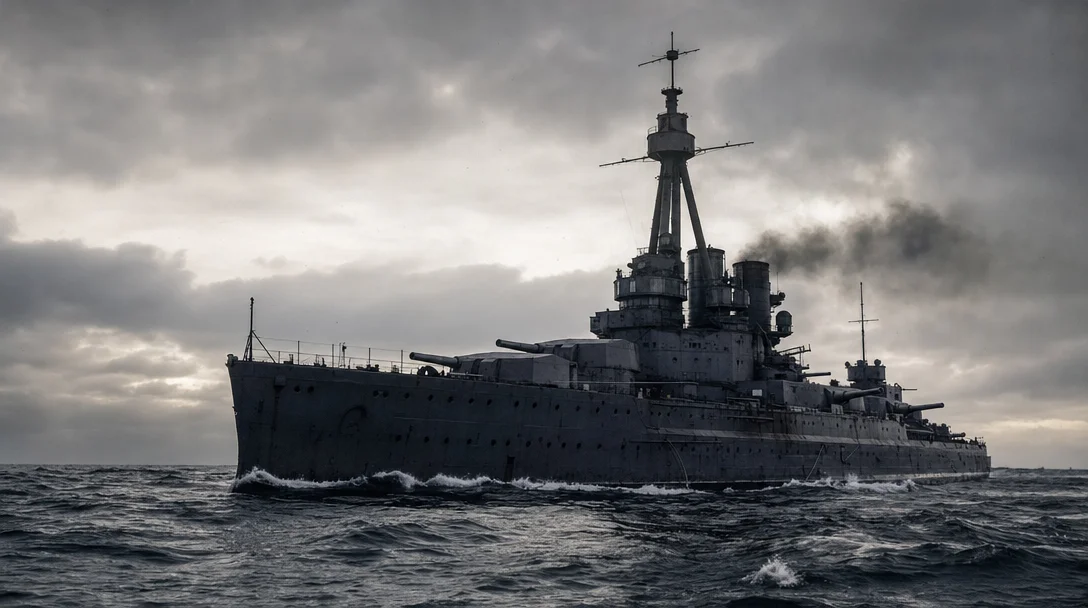
The dreadnought that stumbled into the lead

The dreadnought that stumbled into the lead

SMS Westfalen — Germany's oldest dreadnought, built with Victorian pistons in the age of turbines and an unusual hexagonal gun layout no other navy used — found itself leading the entire High Seas Fleet at Jutland on the night of May 31 to June 1, 1916, a quirk of formation that turned into a short, brutal action against British destroyers. Wikipedia selected it as the Featured Article for June 1, 2026, the 110th anniversary of the battle.

Wikipedia Featured Article
June 1, 2026 · 8:34 AM
2 subscriptions · 3 items
Exactly 110 years ago tonight — the night of May 31 into June 1, 1916 — a German battleship that was supposed to be near the back of the fleet found itself at the very front, steaming alone into a wall of British destroyers in pitch darkness. It had not been ordered there. Its position was a consequence of confusion elsewhere in the line. The ship was SMS Westfalen, the oldest of Germany's four Nassau-class dreadnoughts, and in those few hours it destroyed or crippled more British vessels than almost any other warship in the battle. 1
What makes Westfalen a genuinely interesting ship is not just that night action. It is a vessel defined by a set of engineering compromises that looked like weaknesses and turned out, in different ways, to be beside the point — and whose career ended not on the seabed but in a Scottish port, renamed "D," waiting to be cut up for scrap.

The ship that couldn't leave its own shipyard

The ship was ordered as a replacement for an aging pre-dreadnought ironclad, built under the provisional name Ersatz Sachsen, and laid down at the AG Weser yard in Bremen on August 12, 1907. 1 It was one of four Nassau-class ships — Germany's first generation of dreadnoughts — launched in the same compressed burst of construction as the Anglo-German naval arms race accelerated.
The hull launched on July 1, 1908. Then a problem emerged that no one had fully anticipated: the Weser River was running low. Westfalen, fully fitted, drew too much water to pass through it to the sea. Engineers solved this by strapping six pontoons to the hull to reduce its effective draught; it took two attempts before the ship successfully cleared the shallows. 1 Even at normal water levels, the ship would have been too deep in the draft for the AG Weser yard to complete final outfitting — the navy had outgrown the river it was using to build its fleet.
The whole operation was wrapped in secrecy. Soldiers guarded the shipyard perimeter and the roads leading to Krupp and other major suppliers. Germany was racing to close the gap with Britain, and the details of the Nassau class were not for public view. 1
She was commissioned on November 16, 1909, under Kapitän zur See Friedrich Gädeke. It completed sea trials on May 3, 1910, and joined the High Seas Fleet's First Battle Squadron. 1

The hexagon problem

The Nassau class carries twelve 28 cm SK L/45 guns arranged in six twin turrets — one forward, one aft, and two on each broadside. 1 On a ship diagram this looks like a flattened hexagon, which is exactly what it is. It was unlike anything any other naval power was building at the same moment.
Britain's HMS Dreadnought used five turrets, three on the centerline and two on the wings. The United States' South Carolina placed all four turrets on the centerline in a "superfiring" arrangement, with rear turrets elevated to fire over the forward ones — the design that became standard everywhere. Russia and Italy also chose centerline arrangements. Germany alone put two pairs of turrets on the wings. 1
Loading link preview…
The practical cost was visible in battle: a broadside from Westfalen could bring only eight of its twelve guns to bear on a single target, because the forward and rear turrets pointed away from either flank. A centerline design with the same number of barrels could theoretically aim all twelve at once. 1 German naval planners knew this. The hexagonal layout was a deliberate hedge: wing turrets could fire both broadside and, to a limited extent, across the bow and stern, giving slightly wider coverage arcs, and the design kept the hull narrower than stacking turrets in-line would have required. It was a different set of trade-offs, not simply an inferior one — but most navies eventually concluded the superfiring centerline layout was the better bet.
Then there was the engine question.

Why it still had pistons in 1909

HMS Dreadnought, launched in 1906, used steam turbines. They were smoother, faster, and represented the cutting edge of propulsion technology. The Nassau class, entering service in 1909 and 1910, used reciprocating triple-expansion steam engines — a technology that belonged to the Victorian era. 1
This was not ignorance. In 1905, Germany's naval construction department wrote explicitly that "use of turbines in heavy warships does not recommend itself." 1 The reason was almost entirely financial: Parsons, the British firm that held the dominant turbine patents, was charging one million gold marks per engine in licensing fees. German industry would not be capable of manufacturing large marine turbines domestically until around 1910. The navy chose to save money and build with what it had.
The ship's twelve coal-fired boilers — later supplemented with oil-spray equipment to boost combustion — drove three shafts to a rated 22,000 metric horsepower. Top speed: 20.2 knots. 1 For a dreadnought of 1909 that was adequate, if not impressive. The later German dreadnought classes switched to turbines, and Westfalen's reciprocating machinery became a distinguishing quirk — a reminder of the industrial politics that shaped the fleet.

The night of May 31 to June 1, 1916

At the Battle of Jutland, Westfalen belonged to the Second Division of the First Battle Squadron — near the rear of the German line during the afternoon and evening fighting. 1 Then, after dark, the formation changed.
The Second Battle Squadron maneuvered out of position, and Westfalen — finding itself at the head of the remaining line by default — became the lead ship of the entire High Seas Fleet as it drove southeast toward Horns Reef and home. This was not a tactical appointment. It was a gap in the formation that the ship happened to fill.
Loading link preview…
What happened next was violent and brief. At around 00:30, at a range of roughly 1,800 meters, Westfalen opened fire on HMS Tipperary, the lead British destroyer. The first salvo destroyed the British ship's bridge and forward gun deck. Over the following minutes, Westfalen fired 92 rounds of 15 cm shells and 45 rounds of 8.8 cm shells into Tipperary — which burned and eventually sank. 1
HMS Broke came next. In roughly 45 seconds, Westfalen put 13 rounds of 15 cm and 13 rounds of 8.8 cm into her. Broke was hit at least seven times; 42 of her crew were killed, 6 went missing, and 34 were wounded. An officer aboard the British light cruiser Southampton, watching from a distance, described Broke as "an absolute shambles." 1
HMS Fortune was destroyed by Westfalen and her consort Rheinland together in a matter of seconds, catching fire and sinking. Petard and Turbulent were damaged; Turbulent was later sunk by torpedo boats.
In return, one British 4-inch (10 cm) shell struck Westfalen's bridge. Two men died, eight were wounded, and the captain, Fregattenkapitän Redlich, was lightly injured. 1
By 04:00 on June 1, Westfalen led the fleet across Horns Reef and back to Wilhelmshaven. Over the entire battle, the ship fired 51 rounds from her main 28 cm guns, 176 from the secondary 15 cm battery, and 106 from the 8.8 cm guns. 1

A torpedo hit and a strategic reversal

Eleven weeks after Jutland, on August 19, 1916, the High Seas Fleet sortied again — this time to cover a bombardment of Sunderland by German battlecruisers. Westfalen was at sea, about 55 nautical miles north of Terschelling, when the British submarine HMS E23 put a torpedo into her hull. 1
Some 800 metric tons of seawater flooded in. The anti-torpedo bulkhead held. Three torpedo boats escorted Westfalen back to port at 14 knots; repairs lasted until September 26. 1
The broader strategic context of that day mattered as much as the damage to the ship. Admiral Scheer, commanding the High Seas Fleet, learned during the sortie that the entire British Grand Fleet was bearing down on him — just eleven weeks after Jutland, where he had barely escaped annihilation through a combination of daring maneuver and good luck. He ordered the fleet home. The August sortie was Germany's last serious attempt at a fleet engagement. From that point forward, German naval strategy shifted definitively toward unrestricted submarine warfare.

A battleship in a civil war

The ship's last active deployment was nothing its designers had imagined. In early 1918, Finland — which had declared independence from Russia in December 1917 — descended into civil war between the White Guard and a Red Guard backed by Russian Bolshevik forces. Germany decided to intervene on the White side.
She was designated flagship of the Sonderverband (special detachment), commanded by Rear Admiral Hugo Meurer, tasked with seizing the Åland Islands, landing troops, and supporting coastal operations. 1 On February 24, she left Danzig carrying the 14th Jäger Battalion and a bicycle company — an unusual cargo for a dreadnought.
Sweden had initially granted passage through its territorial waters, then revoked the permission. The German force rerouted through international waters, navigating heavy sea ice around the Åland archipelago. On arrival, the fleet found three Swedish naval vessels — Sverige, Thor, and Oscar II — already there. A standoff followed; after negotiations, the Germans landed on March 7. 1
Loading link preview…
In April, the operation moved to the Finnish mainland. Westfalen and two consorts passed through Helsinki's harbor defenses on April 12 and landed troops in the city. A Russian garrison at the Russarö fortress declared neutrality; British submarines in the harbor scuttled themselves rather than be captured. 1 Street fighting lasted two days; five German sailors from the landing parties died. The White Finnish government consolidated control, and Westfalen remained in Helsinki harbor until April 30 before handing the port facilities over to the Finnish authorities and departing.
It was the last time the ship fired a shot in anger.

The ship renamed "D"

After the armistice in November 1918, the Nassau class — Germany's oldest dreadnoughts — were not among the ships interned at Scapa Flow. They were left in German ports, disarmed, waiting. 1
Article 185 of the Treaty of Versailles required their surrender to the Allied powers. Westfalen was struck from the German Navy list on November 5, 1919. On July 31, 1920, now renamed simply "D," it sailed from Germany to Rosyth, Scotland, arriving August 5 — in company with Helgoland and twelve torpedo boats. 1
The ship was sold to a shipbreaker in Birkenhead. It arrived there on September 3, 1921, was partially stripped, and was then towed to Barrow-in-Furness on May 18, 1922. Dismantling was complete by 1924. 1
The vessel that had led the German fleet home from Jutland, survived a torpedo hit, and occupied the Finnish capital spent its last years as a progressively lighter hulk, towed between British industrial ports until there was nothing left to move.

Wikipedia's Featured Article for June 1, 2026, is SMS Westfalen, chosen on the 110th anniversary of the Battle of Jutland. 2

Add more perspectives or context around this Post.

  • Sign in to comment.