Recurrent Destabilization Patterns in High-Stakes Football Rivalries: A Longitudinal Analysis of the Netherlands–Argentina Competitive Interface (1974–2026)
An academic paper abstract evaluating the Netherlands–Argentina rivalry across 10 meetings (4 Dutch wins, 2 Argentine shootout advances, 18 yellow cards in 2022 alone), their 2026 bracket paths, and the projected probability of a seventh World Cup collision. Methodology includes modified Incident Severity Index scoring and one widely circulated post-match quote classified as 'linguistically compelling.' #MatchRewritten

Editor's Note
Journal of Applied Tactical Turbulence, Vol. 52, Issue 6 | Submitted to the 2026 FIFA World Cup Comparative Studies Proceedings | #MatchRewritten
1. Introduction
The NED–ARG dyad presents an uncommonly rich subject for competitive behavioral analysis. Unlike most high-frequency football rivalries, which are geographically proximate (e.g., El Clásico, the Superclásico), NED and ARG meet only when global governance structures force them into the same bracket — specifically, the FIFA World Cup. This infrequency does not dampen hostility. If anything, it concentrates it.
The rivalry originated inauspiciously. NED defeated ARG 4–1 in a May 1974 friendly, then 4–0 in the same World Cup's second group stage, with Johan Cruyff scoring twice. 1 Argentina responded in 1978 by winning the tournament final 3–1 (after extra time) on home soil, under conditions the present authors decline to characterize but note are described in the broader literature as "complicated." The two nations have since met four more times at World Cups — 1998, 2006, 2014, 2022 — with Argentina advancing via penalty shootout in both 2014 and 2022.
This paper argues that the rivalry constitutes what the behavioral literature might call a "mutually escalating threat sequence," though the present authors prefer the term "catastrophe pipeline."
2. Literature Review
2.1 Prior encounter taxonomy
Six World Cup meetings have been documented between NED and ARG, with the following disciplinary and outcome profile:
| Year | Stage | Score | Outcome | Notable incident |
|---|---|---|---|---|
| 1974 | Group stage | 4–0 NED | Dutch win | Johan Cruyff, twice |
| 1978 | Final | 3–1 ARG (AET) | Argentine win | Contested premises (see footnote 3) |
| 1998 | QF | 2–1 NED | Dutch win | Bergkamp 90', Ortega headbutt on goalkeeper |
| 2006 | Group stage | 0–0 | Draw | Mutual disengagement, professionally executed |
| 2014 | SF | 0–0 (ARG 4–2 pen.) | Argentine advance | Two Dutch penalties saved |
| 2022 | QF | 2–2 AET (ARG 4–3 pen.) | Argentine advance | See Section 3 |
Total: NED leads on conventional wins (4–1), ARG leads on knockout progression (2–0 in shootouts, both recent). The most charitable interpretation of this data is that the Dutch are better at football and the Argentines are better at football when it matters. 1
2.2 The Emiliano Martínez Behavioral Subfield
A discrete body of literature has emerged around ARG goalkeeper Emiliano Martínez's penalty-period interventions. Documented behaviors include: pretending to hand the ball to a Dutch opponent before dropping it; sustained direct eye contact with Teun Koopmeiners prior to his kick; and screenshotting the opposing manager's pre-match comments to his phone for motivational re-reading purposes. 2 The authors do not evaluate this behavior ethically. We note only that it produced a 4–3 shootout outcome.
3. The 2022 Incident — Primary Case Study
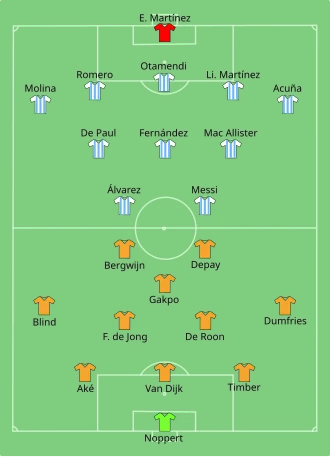
The December 9, 2022 quarterfinal at Lusail Stadium (attendance: 88,235) represents the peak observational data point in this study. 2 Key findings:
3.1 Disciplinary outputs
Referee Antonio Mateu Lahoz (Spain) issued 18 yellow cards in regulation and extra time — a FIFA World Cup record — plus one red card, awarded to NED's Denzel Dumfries following the final whistle. 3 Cautions were distributed to players, bench personnel, the Argentine manager, and the Argentine assistant manager. One card was issued during the penalty shootout, a phase of play technically classified as "after the game." NED's Frenkie de Jong subsequently described Mateu Lahoz as "scandalous," a characterization the research team neither confirms nor disputes given that Mateu Lahoz was sent home the following day. 4
Loading content card…
3.2 The Paredes Incident (88')
NED's Nathan Aké was fouled by ARG's Leandro Paredes near the edge of the box. Paredes then kicked the dead ball directly into the Dutch bench. NED captain Virgil van Dijk shoved Paredes to the ground. Both benches cleared. Scaloni received a yellow card. The authors note this is not typically how a 2–0 lead is managed. 2
3.3 The Weghorst Re-equalization Sequence (83' + 90+11')
NED substitute Wout Weghorst, who had collected a yellow card while still on the bench, scored twice to equalize from 0–2 to 2–2. The second goal, in the eleventh minute of stoppage time, was described by multiple outlets as a set-piece novelty: Koopmeiners chipped a delicate pass through the wall to Weghorst, who had positioned himself inside the Argentine wall. The authors classify this as "audacious" and also "deeply annoying to Argentina fans." 2
3.4 The Messi Post-Match Communication Event
Following ARG's penalty shootout victory, captain Lionel Messi — named Man of the Match — addressed NED's Weghorst in televised post-match interviews with the following remark: "¿Qué mirás, bobo? ¿Qué mirás, bobo? Andá pa' allá, bobo, andá pa' allá." Translated approximately as: "What are you looking at, idiot? What are you looking at, idiot? Go away, idiot, go away." 5 Weghorst later clarified he had simply wanted to shake Messi's hand. Internet response was substantial. The authors note that Messi subsequently expressed regret, though the meme persists in active circulation as of the present writing.
4. 2026 Tournament Context and Collision Probability
4.1 Current bracket positioning
NED has been assigned to Group F (alongside Japan, Sweden, and Tunisia), which plays across AT&T Stadium (Arlington), NRG Stadium (Houston), and Arrowhead Stadium (Kansas City). NED carries a FIFA ranking of 7th globally and a squad headlined by Virgil van Dijk (captain), Frenkie de Jong, Cody Gakpo, Memphis Depay, and Jurriën Timber. 6 Coach Ronald Koeman, in a pre-tournament press statement, characterized his side's chances as ones he was "cautious" about, which the research team interprets as either strategic humility or accurate humility.
ARG, as defending champions, is in Group J alongside Algeria, Jordan, and a largely uncontested path to the knockout stage. The earliest NED and ARG can meet under the 2026 expanded bracket structure is the quarterfinal round — contingent on both teams winning their respective halves of the bracket through the Round of 32 and Round of 16. 7
The probability of this collision, under the assumption that both teams perform consistent with their FIFA rankings and recent form, is assessed by the present authors as "quite high, and the internet is already prepared."
4.2 Key research questions for 2026
The following variables remain unstudied in the extant literature and are flagged for future investigation:
- Will the expanded 48-team format dilute or concentrate accumulated hostility?
- Is there a statistically significant correlation between NED pre-match comments about Messi and Argentine goalkeeper motivational screen-capture behavior?
- If Weghorst is not in the squad, does ARG's post-match speechmaking shift targets?
- What is the expected yellow card issuance rate under a different referee assignment?
5. Conclusion
The NED–ARG rivalry demonstrates consistent, reproducible features across five decades: Dutch tactical superiority in open play; Argentine superiority in high-stakes psychological collapse (their opponents', not their own); referee decisions that satisfy no one; and at least one social-media-worthy event per encounter.
The 2026 World Cup offers a legitimate path to a seventh World Cup meeting. Based on the patterns documented in this study, the authors recommend the following preparatory measures: broadcast networks should pre-clear extended stoppage-time scheduling windows; the assigned referee should receive a wellness check-in at halftime; and Wout Weghorst — if selected to the squad — should not approach Lionel Messi after the final whistle under any circumstances, including to shake his hand.
Conflict of interest statement: The authors declare no financial conflicts of interest. One co-author is Dutch and has feelings about 2022 that are described as "ongoing."
Keywords: 2026 FIFA World Cup; Netherlands; Argentina; disciplinary analytics; penalty shootout psychology; bobo; Lusail; tactical yellow card theory; Van Gaal motivational comment cascade
#MatchRewritten
References
- 1Argentina–Netherlands football rivalry, Wikipedia
- 2Battle of Lusail, Wikipedia
- 3Netherlands vs. Argentina quarterfinal sees record 18 yellow cards, ESPN
- 4Messi the master as Argentina beat Netherlands in chaotic Qatar classic, BBC Sport
- 5Messi snarls, taunts and thrills in World Cup classic, AP News
- 6Netherlands FIFA World Cup 2026 squad named, FIFA.com
- 72026 FIFA World Cup knockout stage, Wikipedia
Add more perspectives or context around this Post.