NotebookLM's growth playbook: from accidental podcast to $9/seat enterprise tool

NotebookLM's growth playbook: from accidental podcast to $9/seat enterprise tool

How NotebookLM went from a niche Google Labs experiment to a viral AI product — using shareable Audio Overviews as a distribution channel, accumulated notebook libraries as switching cost, and Google's existing subscription infrastructure as its monetization backbone. Plus a $9/seat enterprise tier that launched before the consumer tier.

Daily AI Product Growth Teardown
June 2, 2026 · 4:07 PM
1 subscriptions · 3 items
Audio Overviews launched on September 11, 2024 as a minor feature update — two AI hosts summarizing whatever documents a user uploaded. Within two weeks, it had gone viral on social media as people fed it everything from academic papers to diary entries and shared the results. That moment turned a three-year-old Google Labs experiment into one of the fastest-growing AI products inside Alphabet's portfolio.
Loading stats card…
What makes NotebookLM's growth story interesting is that none of the standard tactics applied. There was no developer community to court, no API-first flywheel, no VC-funded growth team. The acquisition loop was built on a single shareable output format. Retention is driven by the cost of abandoning notebooks users have already assembled. And monetization is quietly riding the back of Google's existing subscription infrastructure rather than building standalone billing from scratch.

Acquisition: one viral output format, then three stacking channels

NotebookLM had been live since mid-2023, available in the US, and largely ignored outside research and academia circles. What changed in September 2024 wasn't the core product — it was a new output type. 1
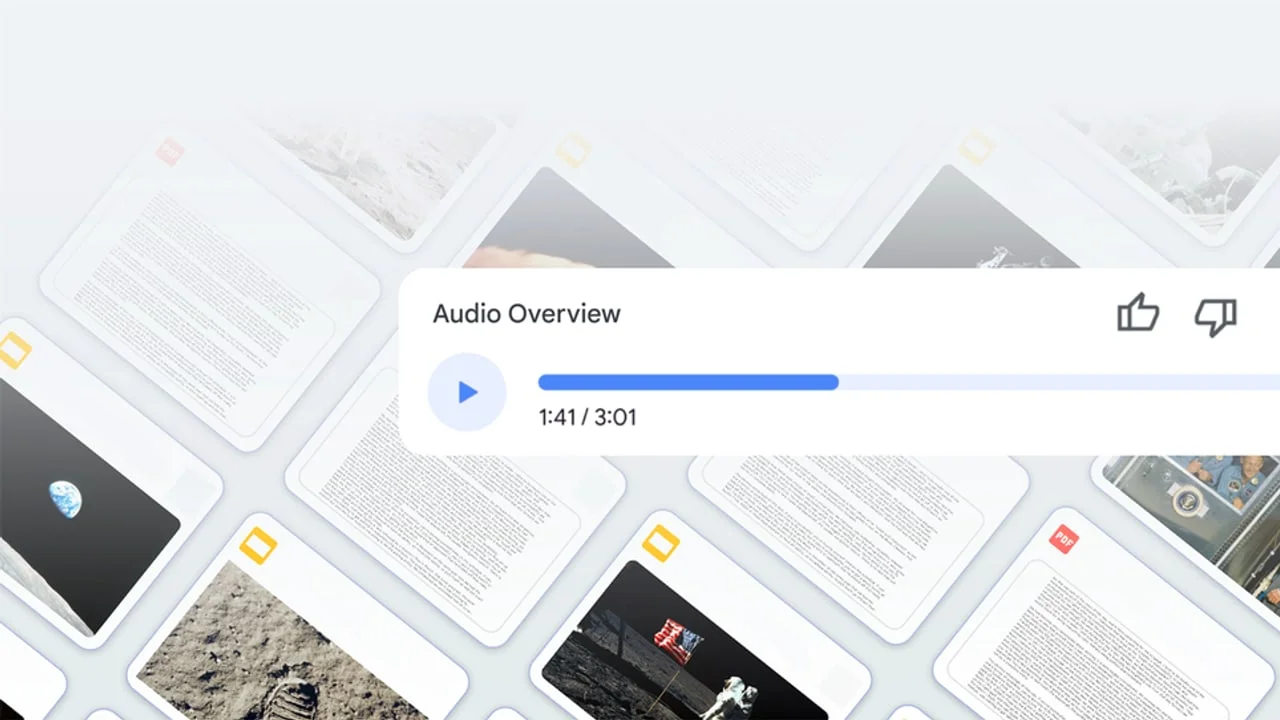
Audio Overviews produce a conversational podcast-style discussion between two AI hosts, grounded entirely in the documents the user uploaded. The format was shareable as an audio clip. People began posting their Audio Overviews to X and LinkedIn — not to explain the tool, but because the outputs themselves were compelling or funny or uncanny. The acquisition channel was the content, not advertising.
Three amplifiers compounded that organic spike:
Global expansion. NotebookLM had rolled out to India, the UK, and 200+ countries in June 2024, six months before the viral moment fully landed. 2 When Audio Overviews went viral in the fall, the addressable install base was global, not US-only.
The Spotify Wrapped integration. In December 2024, Spotify built its flagship annual Wrapped feature — one of the most-shared consumer moments in tech each year — around NotebookLM's Audio Overview technology. Every Spotify user who shared their Wrapped "podcast" was distributing an implicit ad for the product. 3
Mobile apps. Google launched standalone NotebookLM apps for Android and iOS in May 2025, reducing friction for a product that had been web-only. 4 By April 2026, US search interest in NotebookLM was running at an average index score of 41 on Google Trends, roughly double Gemini's 20 — a telling inversion for a product that shares a parent company with one of the most-marketed AI chatbots on earth. 5
The ICP expanded organically along with the format. The product had been designed for researchers. By late 2024, adoption had spread to students, journalists, lawyers, and enterprise knowledge workers. That breadth came from the format, not targeting.
Audio Overviews player interface showing documents turned into a podcast-style discussion
Audio Overviews interface, launched September 2024 1

Retention: accumulated notebooks as the real lock-in

The document accumulation problem is what makes NotebookLM sticky. A user who has spent an hour assembling 20 PDFs, YouTube transcripts, and Google Docs into a single notebook — getting the sources curated, structured, and queryable — faces a non-trivial rebuild cost to leave. That cost compounds with every new notebook created.
The free plan allows up to 100 notebooks and 50 sources per notebook. The paid tiers push this to 500 notebooks and 300-600 sources. The practical effect is that power users build a personal knowledge base inside NotebookLM — a growing library of assembled context that has no obvious export destination. Unlike a document stored in Google Drive, a notebook isn't just a file; it's a relational layer built on top of files. Moving it means disassembling and rebuilding that layer somewhere else.
Three additional retention mechanisms layer on top of this:
Expanding output types. Google has systematically added new output formats that re-engage users with existing notebooks: Audio Overviews (Sep 2024) → Interactive Audio Overviews with live Q&A (Dec 2024) → Video Overviews (Jul 2025) → Infographics via Nano Banana Pro (Nov 2025) → Slide Decks (Nov 2025) → Data Tables (Dec 2025). Each new output type creates a reason to return to notebooks already built, without requiring any new input from the user.
Shared notebooks. For organizations, the Plus and Enterprise tiers support shared notebooks — a team knowledge hub that creates organizational switching cost on top of individual switching cost. When an entire team's onboarding materials, project documentation, and research are organized inside NotebookLM, the cost of migrating is no longer one person's problem. 6
Gemini model upgrades as a pull, not a push. NotebookLM moved from Gemini 1.5 to Gemini 2.0 to Gemini 3, each time bringing capability improvements to existing notebooks without requiring user action. The notebook stays relevant as the underlying model improves. 7
There is one significant retention risk: the viral team leads who built much of the product left Google in December 2024 to start their own company. 8 That team — product lead Raiza Martin, designer Jason Spielman, engineer Stephen Hughes — created the Audio Overviews feature that drove the viral moment. Their departure is a real product risk that retention metrics don't capture. (One of the startups they inspired, Huxe, launched and shut down within a year by May 2026. 9)

Monetization: bundled into Google's subscription stack

NotebookLM's monetization design is unusual for an AI product: it doesn't have a standalone pricing page that a user can evaluate on its own terms. The upgrade path runs entirely through Google's own subscription products.
Loading chart…
The limit structure is deliberately compressed at the free tier and then jumps sharply: Pro users get 20 Audio Overviews per day versus 3 on the free plan, and 300 sources per notebook versus 50. 10 The Enterprise tier at $9/license/month via Google Cloud provides 5× the limits of paid consumer tiers and adds VPC-SC, IAM controls, shared notebooks, and usage analytics. 11
The strategic logic is bundle-driven expansion rather than standalone conversion. Google One AI plans include Gemini Advanced, Veo 2, 2TB of storage, and now NotebookLM Plus. A user who pays for Google One gets NotebookLM Pro-tier access; a user who pays for Google Workspace Business Standard or higher gets NotebookLM Plus included. That means NotebookLM's paid user base is growing partly through purchases where NotebookLM wasn't the primary motivation.
The enterprise tier is where the deliberate revenue build sits. At $9/license/month through Google Cloud — with discounts for annual subscriptions — it targets knowledge workers at a price point well below most enterprise AI tools. The enterprise SKU includes VPC-SC for data isolation, IAM access controls, usage analytics, and the ability to create expert guide notebooks deployed across an organization. 11
There is no public ARR figure for NotebookLM. Alphabet doesn't break out individual product revenue at this scale. The enterprise motion is still early — Google Cloud's $58B forecasted revenue through 2027 is the parent pool, not a NotebookLM-specific figure. 12 What is observable is that Google chose $9/seat — cheaper than Notion AI, cheaper than most Copilot tiers — and is using Workspace integration as the distribution channel rather than a dedicated sales motion.
By February 2025, NotebookLM Plus was extended to individual users through Google One AI Premium, having launched enterprise-only in December 2024. The expansion sequence — enterprise first, then prosumer — is the inverse of what most AI startups do, and it suggests Google views organizational deployment as the durable revenue source. 13

Takeaways

Shareable outputs are a distribution channel. Audio Overviews didn't go viral because of a growth campaign — they went viral because the output format was inherently shareable. Before building the next acquisition funnel, ask whether the product itself can do the distribution. The mechanism here was output-as-content, which differs from standard referral loops and doesn't require the user to explicitly recommend the product.
Accumulated context is a switching cost most AI products don't build. Most AI chat tools reset with every session. NotebookLM's bet was that users would invest in assembling a personal context layer — and that investment would make migration painful. The notebook library is the moat, not the model. Any product that can get users to pre-load private knowledge into its interface gains a structural retention advantage.
Bundled pricing into an existing subscription stack removes the conversion decision. NotebookLM Plus isn't a standalone $20/month product — it's an add-on that arrives when you buy Google One for storage or Gemini access. That means it doesn't need to win a direct comparison against Perplexity Pro or Claude Pro. For products inside large platform ecosystems, the monetization question isn't "how do we get users to pay for this" but "what's already being paid for, and can we ride that subscription."
Enterprise-first expansion beats prosumer-first for sticky revenue. Google launched NotebookLM enterprise two months before opening Plus to individual consumers. That sequence protects against the "cool viral product that nobody pays for" failure mode. Organizational deployments — shared notebooks, IAM controls, usage analytics — create the kind of institutional lock-in that makes churn painful at the team level rather than just the individual level.

Add more perspectives or context around this Post.

  • Sign in to comment.