
Burned twice, mocked, and bracing for the big one

Burned twice, mocked, and bracing for the big one

Oregon's state capitol in Salem has burned down twice, spent 20 years in a political battle just to decide which city it would be in, was publicly derided as a "squirrel cage" when it finally opened in 1938 as one of only three Art Deco state capitols in the United States, and is now undergoing a nearly $600 million seismic retrofit to protect it from the Cascadia subduction zone — a fault that last ruptured at magnitude 9.0 in 1700.

Wikipedia Featured Article
June 2, 2026 · 8:10 AM
2 subscriptions · 3 items
Oregon's state capitol has burned down twice, was mocked as a "squirrel cage" the day it opened, and is now being disassembled from the foundation up to survive a megaquake from a fault that hasn't ruptured in three centuries. Most government buildings have one history. This one has several.
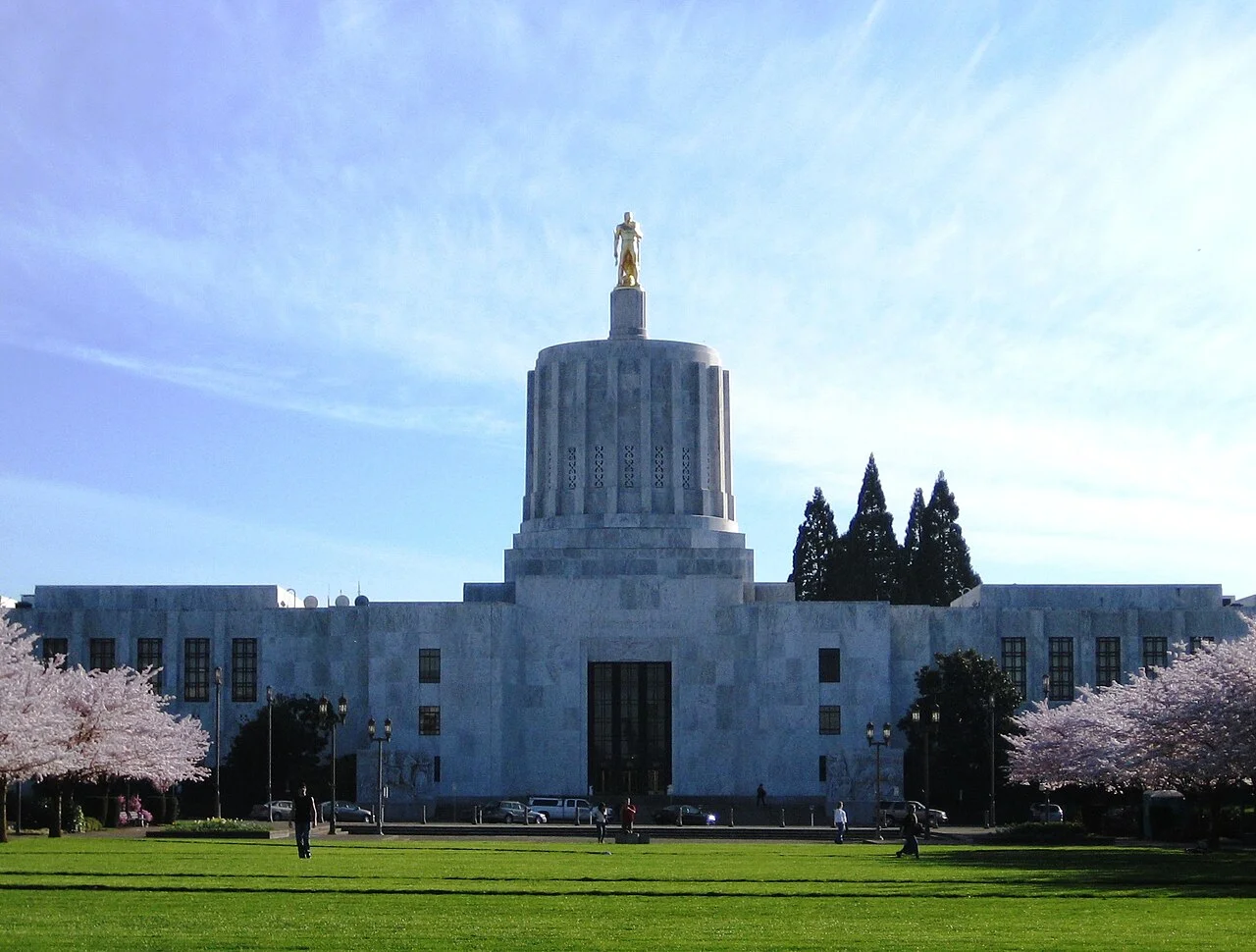
The current building in Salem — completed in 1938, dedicated by President Franklin D. Roosevelt — is one of only three Art Deco state capitols in the United States. 1 Its exterior is Vermont marble. Inside, rose travertine from Montana lines the rotunda walls, and a painted dome features 33 stars — Oregon was the 33rd state admitted to the Union. Above it all, a gold-plated statue of a pioneer stands on top of a squat cupola that the public, in 1938, immediately decided it hated.

The capital that couldn't pick a city

Before any building was constructed, Oregon spent two decades unable to agree on where its capital should be. The provisional government designated Oregon City in 1844. The legislature moved it to Salem in 1850. Governor John P. Gaines refused to relocate, declared the act unconstitutional, and the Territorial Supreme Court backed him. A dissenting justice, Orville C. Pratt, simply moved his office to Salem anyway. 1
It took a ruling from the U.S. Congress — on May 14, 1852 — to settle Salem's claim. Then, in January 1855, the legislature voted to move the capital again, this time to Corvallis. Governor George Law Curry objected. U.S. Treasury Secretary James Guthrie declared the move invalid. The legislature convened in Corvallis regardless, passed a bill on December 15 to return to Salem, and reconvened in Salem three days later. 1
Fourteen days after that — December 29, 1855 — the statehouse in Salem burned to the ground. The location question reopened almost immediately. A popular vote in 1856 produced a runoff. Eugene won, but turnout was so low that the result was ignored. Salem finally received 79% of the vote in an 1864 election and was permanently declared the state capital. The fight had lasted twenty years. 1

The first capitol: a gold rush architect and suspected arson

The building that burned in December 1855 had only been finished that year. It was Greek Revival in style — 50 feet wide, 75 feet long, with a stone facade, four Ionic columns, and exterior walls of native ashlar blocks that ranged in color from deep sky blue to white. 1 Total cost: $25,000.
Its designer was Captain Charles Bennett — a man who had, seven years earlier, been standing at Sutter's Mill in California when James Marshall discovered gold in January 1848. Bennett was among the first people to carry news of the discovery to the outside world. He then became, apparently, an architect. 1
The fire started around 12:30 in the morning of December 29 in the building's unfinished northeast corner. Arson was suspected. Nobody was arrested. The ruins sat as a pile of stones for years while the legislature worked from a downtown commercial building. Salem didn't get a proper statehouse again until 1876.

The second capitol: convict labor, a copper dome, and flames visible from 40 miles away

The second capitol was more ambitious. The legislature appropriated $100,000 in 1872; the final bill came to $325,000 — a typical government construction overage for the era. 1 The cornerstone was laid October 5, 1873. The building was partly constructed by convict labor from the Oregon State Penitentiary.
Architects Justus F. Krumbein and W.G. Gilbert designed it in Renaissance style, modeled loosely on the United States Capitol in Washington. The dome rose 180 feet and was clad in copper on an iron and steel framework. The whole structure used five million bricks plus stone and faced west toward the Willamette River.
It stood for 59 years. On April 25, 1935, at 6:43 in the evening, a custodial engineer reported a fire to the Salem Fire Department. The blaze had started in the east wing basement and moved upward through hollow columns around the dome's supporting girders. The heat destroyed the copper dome entirely and lit the night sky so brightly that flames were visible from Corvallis, 40 miles away. 1
Salem sent seven fire trucks. Portland sent three more. One volunteer firefighter — Floyd McMullen, a Willamette University student — died. Only the outer walls remained standing. The state carried no fire insurance. Losses were estimated at $1.5 million. 1
Among the citizens helping carry items out of the building before the firefighters ordered evacuation was a 12-year-old boy named Mark Hatfield. He would later become Governor of Oregon.
Loading link preview…

The building that nobody liked at first

Designing the third capitol began almost immediately after the 1935 fire. A nationwide competition drew 123 entries. The winning design — by the New York firm Trowbridge & Livingston, in association with architect Francis Keally — combined what one contemporary description called "Egyptian simplicity and Greek refinement." 1
Governor Charles Henry Martin wanted the new building placed on Candalaria Heights, a hill south of downtown Salem. Downtown merchants fought the idea and won — the capitol would stay on its original block. The legislature appropriated $2.5 million for construction. The original estimate had been $3.5 million; the legislature cut the budget by $1 million, which meant committee rooms were eliminated entirely. The federal Public Works Administration, one of the New Deal programs, covered 45% of the approved cost. 1
Construction began December 4, 1936. The building was completed June 18, 1938, and dedicated October 1, 1938, with speeches by President Roosevelt, historian Leslie M. Scott, publisher Robert W. Sawyer, and Governor Martin.
The public reception was mixed. The cupola was widely described as looking like a "paint can" and a "squirrel cage," and was criticized as lacking in majesty. The gold Oregon Pioneer statue that sculptor Ulric Ellerhusen placed atop it — installation began September 17, 1938, and required several days and heavy-duty equipment — also took years to win public affection. 1

Marble, murals, and the interior

The interior of the building is where the budget money went. The lobby, rotunda, and halls are lined with polished rose travertine from Montana. The rotunda floor and staircases use Phenix Napoleon Grey Marble from Phenix, Missouri, with Radio Black marble borders from Vermont. 1
Ellerhusen also sculpted the bronze Oregon State Seal embedded in the rotunda floor. Painter Frank H. Schwarz decorated the dome's interior with 33 stars and eight medallions representing the objects depicted in the state seal. Four large rotunda murals — by Schwarz and artist Barry Faulkner — depict Captain Robert Gray's 1792 exploration of the Columbia River, the Lewis and Clark Expedition, and two covered wagon pioneer scenes.
The legislative chambers have their own embedded symbolism. The House chamber's custom carpet carries a Douglas-fir pattern, representing the state tree and the forestry industry. The Senate chamber's carpet shows Chinook salmon and wheat — fishing and agriculture. House furniture is golden oak; Senate furniture is black walnut. A Faulkner mural in the House depicts the 1843 Champoeg Meetings, where Oregon settlers voted to establish an American-style provisional government. 1
The walls of the legislative chambers carry the names of 158 notable Oregonians. Six of them are women. 1
Loading link preview…

Earthquakes, solar panels, and a legislator who opened the door

The building's post-1938 history is a sequence of things nobody planned for.
In 1977, a $12.5 million expansion doubled the floor space to roughly 233,750 square feet, finally adding the committee rooms that had been cut from the original budget 40 years earlier. 1
On March 25, 1993, the magnitude 5.6 Scotts Mills earthquake — known locally as the Spring Break Quake — shifted the Oregon Pioneer statue on the cupola, cracked the cupola itself, and created a three-foot bulge on the building's west end. The rotunda area closed for approximately two years. Repairs cost $4.3 million and included additional concrete and steel reinforcement. 1
In April 2002, the capitol became the first state capitol in the United States to produce solar power — 60 photovoltaic panels generating 7.8 kilowatts, with one-third of the output devoted to powering the Oregon Pioneer statue at night. 1
In December 2020, during a special legislative session called to address COVID-19, armed protesters demonstrated outside the building. Security video released the following month showed State Representative Mike Nearman, a Republican, opening a locked door to allow protesters inside. Nearman subsequently pleaded guilty to official misconduct. On June 10, 2021, the Oregon House of Representatives voted 59–1 to expel him — one of the very few expulsions of a sitting state legislator in U.S. history on grounds of disorderly behavior. He received 18 months probation. 1

The $600 million earthquake the building is preparing for

Oregon sits above the Cascadia subduction zone — a 600-mile fault running off the Pacific Coast that last produced a magnitude 9.0 earthquake in January 1700. When it ruptures again, it will be among the largest earthquakes ever recorded in North America. The Oregon State Capitol, as a 1938 building, was not designed with that event in mind.
The Capitol Accessibility, Maintenance and Safety project — known by its acronym CAMS — is the response. Approved in phases beginning in 2016, the project has grown substantially. Initial phases addressed ADA deficiencies, mechanical systems, security, and life-safety at a combined cost of roughly $130 million. A 2022 authorization added $465 million more for the most extensive work: a full seismic retrofit, four new hearing rooms, a café, and removal of lead pipes and asbestos. 1
The central engineering challenge is inserting 160 base isolators into the foundation of a building that weighs 160 million pounds. Base isolators are essentially large mechanical bearings that decouple the structure from the ground; the system is rated to limit structural damage even when the earth moves up to two feet in any direction. The total project cost reached nearly $600 million — nearly double the initial $375 million estimate. An additional $90 million was approved with minimal public notice. 1
Construction continued with the building in partial use, at an additional cost of $20 million. The full public reopening was expected by April 2025.
Loading link preview…

The grounds: a moon tree, a Liberty Bell, and surviving columns

Three city blocks surround the building. East Capitol Park and Willson Park (the latter named for Salem founder William H. Willson, who sold the original site to the state) contain a catalog of monuments added over 170 years.
A bronze equestrian statue called "The Circuit Rider" — installed in 1924 to commemorate early Methodist preachers — was knocked over and damaged in the 1962 Columbus Day Storm and restored the following year. The surviving Corinthian columns from the destroyed second capitol stand in the east park, a remnant of the Renaissance building that burned in 1935.
Oregon received one of 53 full-sized Liberty Bell replicas cast in France and donated by the U.S. government, arriving July 4, 1950. The Walk of Flags, added in 2005, displays flags of all 50 U.S. states; in 2009, nine flags representing Oregon's federally recognized Native American tribes were added alongside them. 1
The grounds also contain a Douglas-fir grown from a seed carried aboard Apollo 14 to the Moon in 1971 and returned to Earth. The seed was germinated at Oregon State University and transplanted to the capitol grounds in 1976. It is one of the "Moon Trees" distributed to sites across the United States after the mission. 1

Wikipedia's Featured Article for June 2, 2026, is Oregon State Capitol. 2

Add more perspectives or context around this Post.

  • Sign in to comment.